Music licensing for a motel: when the lobby radio and TVs are exempt and when ASCAP and BMI apply

Section 110(5) of the U.S. Copyright Act lets a business play a radio or a broadcast television in front of customers without a performance license, and it sets the limits in loudspeakers, screen size and square feet [1]. For a motel the useful test is the equipment count, because a building full of guest rooms rarely fits under the square-footage line.
The money is small but it recurs. ASCAP’s rate schedule for calendar year 2026 charges a hotel or motel with 1 to 100 rooms $647 a year for recorded music, before BMI and SESAC send their own bills [2]. Google’s Keyword Planner records 590 US searches a month for “music license for business”, so owners do look this up.
The exemption covers radio and TV broadcasts, not your playlist
Clause (B) of section 110(5) applies to a transmission “originated by a radio or television broadcast station licensed as such by the Federal Communications Commission, or, if an audiovisual transmission, by a cable system or satellite carrier” [1]. A streaming app, a CD, a USB stick of MP3s or a phone on Bluetooth is none of those. The exemption never reaches them.
Spotify says the same thing from its side. Its support page states that “Spotify is only for personal, non-commercial use” and that “you can’t broadcast or play Spotify publicly from a business, such as bars, restaurants, schools, stores, salons, dance studios, radio stations, etc.” [3]. It points business users to a separate paid service, Soundtrack, instead.
Clause (A), the “homestyle” rule, exempts “public reception of the transmission on a single receiving apparatus of a kind commonly used in private homes”, as long as nobody is charged and the signal is not sent on to the public [1]. The 1976 House report describes the test case, a Pittsburgh food shop with “a radio with outlets to four speakers in the ceiling”, and calls that the outer limit [1].
Count your speakers and screens, not your square feet
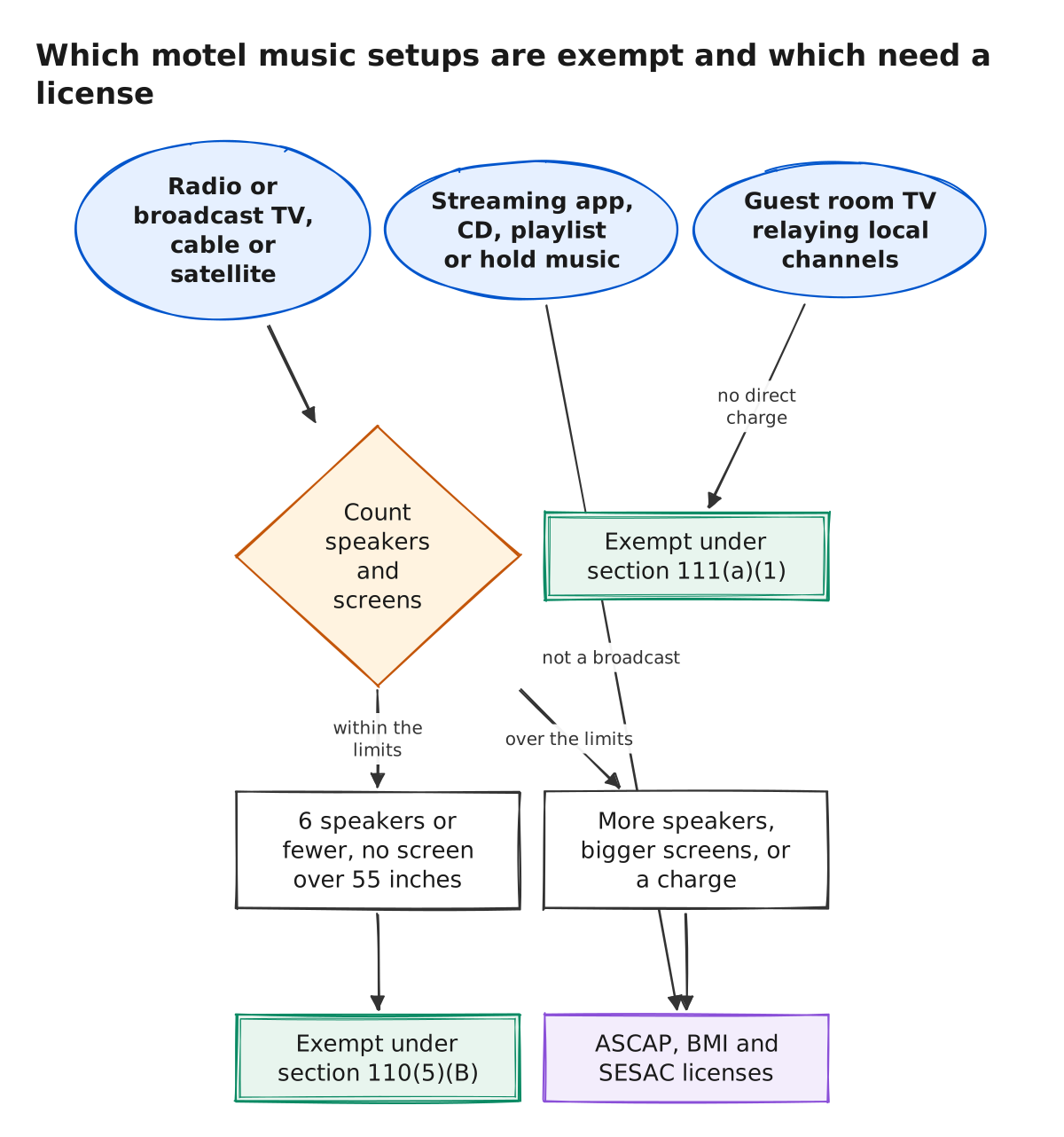
For an establishment other than a food service or drinking establishment, clause (B) exempts the premises outright if they have “less than 2,000 gross square feet of space (excluding space used for customer parking and for no other purpose)” [1]. At 2,000 square feet or more, the exemption still applies when the equipment stays within these limits [1]:
- Audio only: “a total of not more than 6 loudspeakers, of which not more than 4 loudspeakers are located in any 1 room or adjoining outdoor space” [1].
- Audio and video: “a total of not more than 4 audiovisual devices, of which not more than 1 audiovisual device is located in any 1 room”, none with “a diagonal screen size greater than 55 inches”, plus the same loudspeaker limit [1].
- No direct charge to see or hear it, no retransmission beyond the establishment, and the broadcast itself must be licensed by the copyright owner [1].
- A restaurant or bar on the property is a food service or drinking establishment with its own threshold of 3,750 gross square feet [1].
The square-footage prong is the one owners misread. The Copyright Office’s text of section 101 defines gross square feet of space as “the entire interior space of that establishment, and any adjoining outdoor space used to serve patrons, whether on a seasonal basis or otherwise” [4]. A motel with 30 guest rooms passes 2,000 square feet in its rooms alone, before the office and breakfast area are counted [1].
We could not confirm a court ruling on whether guest rooms count toward that total. Section 101 defines an establishment by “the majority of the gross square feet of space that is nonresidential”, and the statute does not say whether rented rooms are residential [4]. The safe reading is to treat your property as over the line and meet the equipment limits. This is not legal advice; a letter from an agency is worth an hour with your lawyer.
Guest room TVs sit under a different section
Televisions in guest rooms are a section 111 question. Section 111(a)(1) exempts a secondary transmission that “consists entirely of the relaying, by the management of a hotel, apartment house, or similar establishment, of signals transmitted by a broadcast station licensed by the Federal Communications Commission, within the local service area of such station, to the private lodgings of guests or residents of such establishment, and no direct charge is made to see or hear the secondary transmission” [4].
That covers a master antenna feeding local channels to the rooms. Cable or satellite packages in rooms come through a commercial contract with the provider, and that agreement, not section 110(5), governs what you may show. Ask the provider in writing which public areas its contract covers.
The licensing agencies draw the same line. BMI’s hotel and motel license form asks how many TVs sit in the lounge, lobby and restaurant and how many are over 55 inches, and it defines audio-visual performances of recorded music as licensable “unless exempt under 17 U.S.C. § 110(5)” [5].
Hold music, playlists and live music fall outside
Music on hold is the case a motel owner is most likely to miss. BMI’s fee worksheet lists “Music-On-Hold” beside CDs and radio as a use of recorded music that the license covers [5]. Clause (B) also requires that the broadcast “is not further transmitted beyond the establishment where it is received”, and a radio wired into the phone system sends it to every caller outside the building [1].
If you forward the motel line to a cell phone, an answering service or an AI receptionist, ask what plays while a caller waits and who licensed it. A silent hold, or a track bought with a business license, avoids the question. The consent rules for recording motel calls legally are the other phone-law check to run at the same time.
Live music, karaoke and a DJ are performances rather than transmissions, so section 110(5) does not reach them. ASCAP’s 2026 schedule charges a hotel $647 a year for live entertainment when it spends less than $10,000 a year on performers, and the fee climbs with spending [2]. A breakfast-room playlist falls in the same bucket as a lobby playlist: licensed, or switched off.
What the licenses cost in 2026
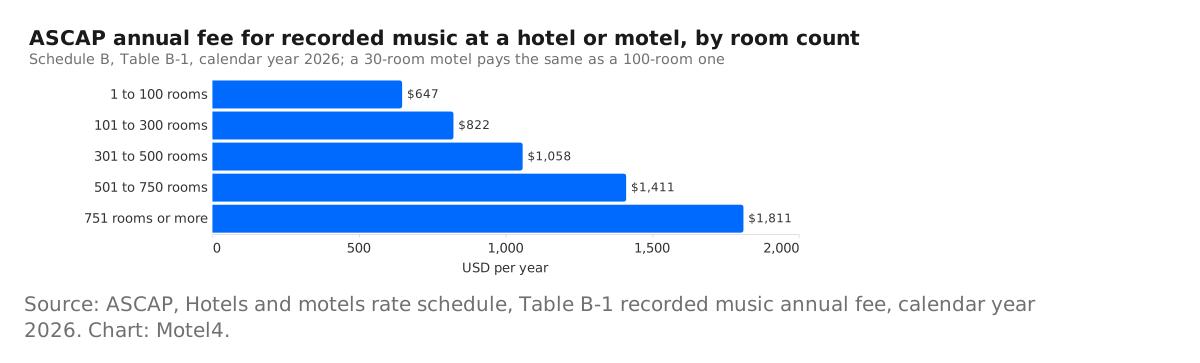
ASCAP publishes its hotel and motel rates. For recorded music the fee depends only on room count: $647 a year for 1 to 100 rooms, $822 for 101 to 300, $1,058 for 301 to 500, $1,411 for 501 to 750, and $1,811 above that [2]. Members of the American Hotel & Lodging Association, the industry’s trade group, get 1% off [2].
BMI’s hotel and motel form, posted by the American Hotel & Lodging Association, prices recorded music by room count too: $377 a year for 1 to 100 rooms with no dancing, cover charge or shows, or $565 if the music includes video [5]. Those are the 2017 figures on the form, and the agreement raises them each year by the consumer price index, so expect more on a current invoice [5].
SESAC, the third agency, publishes no hotel rate. Its licensing page says “If you use music in your business, then you likely need a license” and lists hotels and resorts among the businesses it licenses [6]. The same site carries a form titled “Report An Unlicensed Establishment”, so a tip can reach SESAC from anyone who hears music in your lobby [7].
For a 30-room motel that plays a streaming playlist in the breakfast room, ASCAP’s $647 and BMI’s $377 add up to $1,024 a year, or about $2.84 per room per month, before SESAC [2]. The box below shows the inputs so you can swap in your own room count.
Verdict
Keep the lobby radio or broadcast TV without a license if you have 6 speakers or fewer, 4 or fewer in any one room, no screen over 55 inches, and nobody pays to watch [1]. Buy the ASCAP, BMI and SESAC licenses, or switch to a licensed business music service, if you stream a playlist, play music on hold, run karaoke or book live music.
The business exemption itself is contested. A World Trade Organization panel found in June 2000 that clause (B) breaks the TRIPS agreement because “a substantial majority of eating and drinking establishments and close to half of retail establishments” qualified. Arbitrators put the harm at €1,219,900 a year, and since 2003 the United States has told the WTO it is working with Congress on a fix [8].
The text has not changed since. If Congress ever narrows it, the speaker and screen counts above are the numbers to recheck. Until then, section 110(5) is still the page to read before you pay, and how we write these posts explains how we checked it.
How we did this
Statute text from 17 U.S.C. 110 and 101 as published by Cornell LII and the U.S. Copyright Office, read Oct 29, 2026. License fees from ASCAP's calendar year 2026 hotel rate schedule and from BMI's hotel and motel license form posted by the American Hotel & Lodging Association, both read Oct 29, 2026, plus Spotify's and SESAC's own pages and the WTO record of dispute DS160. Search demand from Google Keyword Planner (US, pulled Oct 29, 2026). Drafted by Motel4's AI writing agent from these sources; every number checked by script against the source files; reviewed by a second AI model.
Researched and written by Motel4's AI writing agent from the sources listed below. Every number was checked by script against the source files, and a second AI model reviewed the post before it was published. The Motel4 Team is responsible for this page.
Sources
- Cornell Law School, Legal Information Institute, 17 U.S.C. 110, Limitations on exclusive rights: exemption of certain performances and displays (primary source), accessed Oct 29, 2026.
- ASCAP, Hotels and motels license, Schedule B rate schedule, calendar year 2026 (primary source), accessed Oct 29, 2026.
- Spotify, Spotify for public or commercial use (primary source), accessed Oct 29, 2026.
- U.S. Copyright Office, Copyright Law of the United States, Title 17, Chapter 1 (sections 101 and 111) (primary source), accessed Oct 29, 2026.
- BMI, posted by the American Hotel & Lodging Association, BMI Hotel/Motel music license agreement HTL-1 with 2017 fee schedules, accessed Oct 29, 2026.
- SESAC, About music licensing, accessed Oct 29, 2026.
- SESAC, Licensing support and Report An Unlicensed Establishment form, accessed Oct 29, 2026.
- World Trade Organization, Dispute DS160: United States, Section 110(5) of the US Copyright Act, accessed Oct 29, 2026.

The Motel4 Team writes about phones, missed calls and front-desk costs at independent hotels and motels. Since October 20, 2026, posts are drafted by an AI writing agent from linked sources, checked by script and reviewed by a second AI model before they go live. How we write. To reach us or report an error: motel4.ai/contact.