Innkeeper liability: California's $500 valuables cap needs a safe notice, Florida's needs a receipt form

California Civil Code section 1860 lets a motel cap what it owes for a guest’s lost cash or jewelry at $500 [1]. Innkeeper liability shrinks that far only on two conditions: the property “keeps a fireproof safe,” and it tells guests so, in person or “by putting up a printed notice in a prominent place in the office or the room” [1]. Skip either and the section does not protect you.
Florida draws the line somewhere else. Its statute, section 509.111, never asks for a safe; the paper that matters is a receipt form printed with a $1,000 limit, or an inventory the guest files before a loss [2]. A small motel that copies a sign from a chain hotel in another state can end up with neither protection.
Innkeeper liability starts at full value, and the statutes are the exception
Under the old common-law rule, an innkeeper owed a guest the full value of lost property unless nature, civil unrest or the guest’s own fault caused the loss, according to a 2018 bulletin from Adjusters International, a public adjusting firm [3]. State statutes cut that down, usually to a figure between $250 and $2,000, for owners who meet their conditions [3].
That last clause is what most summaries rush past. The cap is earned with a safe, a sign and sometimes a form. Below are the exact conditions in two states, quoted from the statute text, so you can hold your own front office up against them.
California’s $500 cap needs a fireproof safe and a notice
Section 1860 covers “money, jewelry, documents, furs, fur coats and fur garments, or other articles of unusual value and small compass” [1]. If the safe exists and the notice was given, the operator is not liable for those items when the guest did not deposit them, “except so far as his own acts shall contribute thereto” [1].
The ceiling applies even then. The section says the operator is not liable “in any case for more than the sum of five hundred dollars ($500)” for all such property of one guest, “unless he shall have given a receipt in writing” [1]. A receipt from your desk clerk lifts the cap for what it covers.
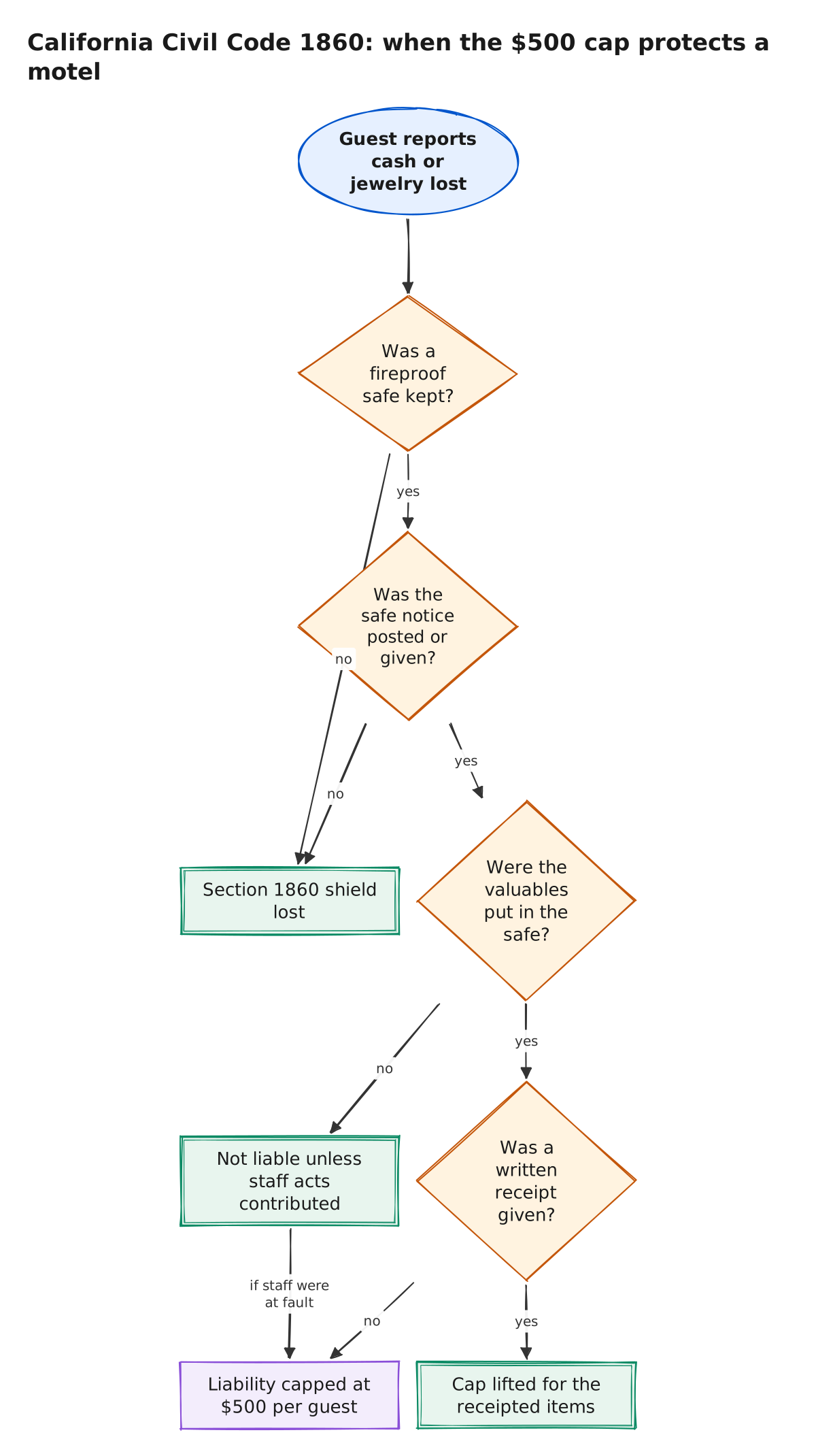
Read the diagram from the top. A “no” at “Was a fireproof safe kept?” or at the notice question sends the claim to “Section 1860 shield lost.” A “yes” at both, with nothing deposited, leaves the motel liable only where staff acts contributed, and then “Liability capped at $500 per guest.” The last question, “Was a written receipt given?”, is the one owners forget [1].
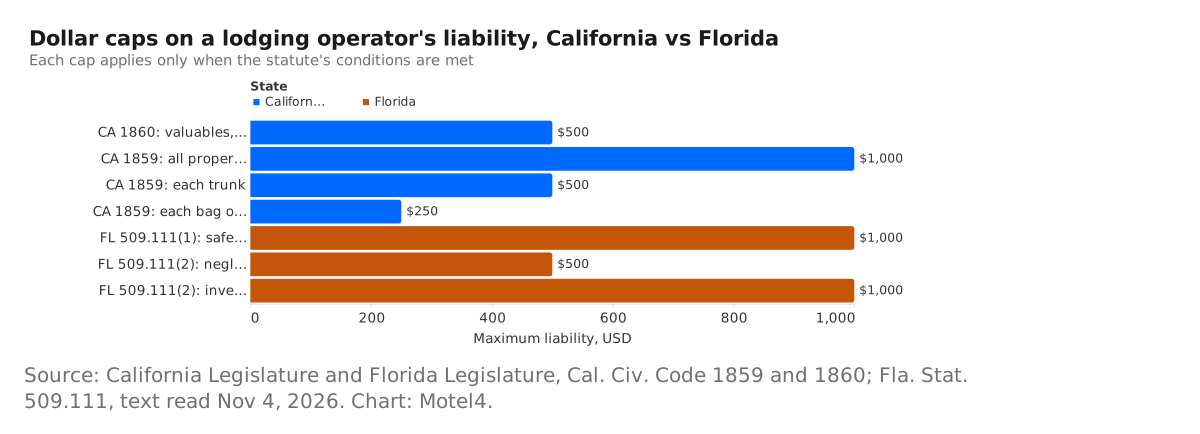
Everything else a guest brings sits under section 1859, the neighboring section. There the operator is liable as a “depositary for hire,” capped at $1,000 in total, $500 for each trunk and its contents, $250 for each valise or traveling bag, $250 for each box, bundle or package, and $250 for all other personal property [4]. Agreeing in writing to more raises those limits [4].
Florida’s caps hinge on a receipt form and a guest inventory
Florida starts by saying the operator “is not under any obligation to accept for safekeeping any moneys, securities, jewelry, or precious stones” [2]. If you do accept them, you are liable only for losses caused by your fault or negligence. The $1,000 limit holds only if you gave a receipt stating the value, on a form that says, “in type large enough to be clearly noticeable,” that you are not liable beyond $1,000 [2].
For clothing, goods and other property, the operator is liable only for fault or negligence, and then for no more than $500, unless the guest filed an inventory with values before the loss and let the operator inspect it [2]. With an inventory on file, the cap rises to $1,000 [2].
Florida’s sign on the wall is a different document. Section 509.101 lets an operator set reasonable house rules, printed in English and posted “in a prominent place,” and says those rules “shall control the liabilities, responsibilities, and obligations of all parties” [5]. That makes the posted rules sheet the place to restate how valuables are handled.
A $1,500 ring and $400 in cash: what the motel owes
Take a guest at a California motel who reports a ring worth $1,500 and $400 in cash missing from the room, neither placed in the office safe. Those two values are our assumptions. If the safe exists and the notice was posted, the motel owes nothing unless staff acts contributed, and at most $500 even then [1]. That leaves $1,400 of the claim above the cap.
The same loss at a Florida motel reaches the same $500 ceiling by another route: liability only for negligence, and no inventory on file [2]. If the California motel had no posted notice, it argues without section 1860 at all, starting from the common-law rule of full value [3].
Placement matters as much as wording. In Paraskevaides v. Four Seasons, a District of Columbia case, a guest lost jewelry worth $1.2 million from an in-room safe; the hotel had posted its notice in guest rooms but not in the public area, and the appeals court held the $1,000 statutory limit did not apply [3]. Like call-recording consent, these rules change at the state line.
A short checklist from the two statutes:
- California: keep a fireproof safe in the office, and post a printed notice naming the section 1860 items in the office and in each room [1].
- California: decide who may write receipts for deposits, because a written receipt lifts the $500 ceiling [1].
- Florida: print the safekeeping receipt with the $1,000 limit in large type [2], and restate the valuables policy in the posted house rules [5].
We could not confirm whether a California court would treat a laptop as an article “of unusual value and small compass” under section 1860 [1]; if not, section 1859’s $250 limit for other personal property may be the one that applies [4]. We also could not confirm that an in-room safe counts as the fireproof safe the statute names. This is not legal advice: have a local lawyer or your insurer check your notice and receipt wording.
Verdict
Pick the posted-notice route if you run a California motel: keep a fireproof safe, give the section 1860 notice in the office and every room, and a guest’s undeposited valuables cost you at most $500 [1]. Choose a large-type receipt form if you run a Florida motel and accept valuables at the desk, because without it the $1,000 cap does not attach [2].
Before printing either, read your own state’s section. The two states here disagree on whether a safe is required, what the sign must say and what the cap is, so a template borrowed from elsewhere protects nobody.
How we did this
Search demand from Google Keyword Planner (US, pulled Nov 4, 2026). Statute text of California Civil Code 1859 and 1860 and Florida Statutes 509.101 and 509.111 read on Nov 4, 2026; the top search result for the query was read the same day to find what it leaves out. Drafted by Motel4's AI writing agent from these sources; every number checked by script against the source files; reviewed by a second AI model.
Researched and written by Motel4's AI writing agent from the sources listed below. Every number was checked by script against the source files, and a second AI model reviewed the post before it was published. The Motel4 Team is responsible for this page.
Sources
- California Legislature (via California.Public.Law), California Civil Code section 1860 (primary source), accessed Nov 4, 2026.
- The Florida Senate, Florida Statutes 509.111, Liability for property of guests (2024) (primary source), accessed Nov 4, 2026.
- Adjusters International, Innkeeper's Liability for Loss to Guest's Property, accessed Nov 4, 2026.
- California Legislature (via California.Public.Law), California Civil Code section 1859 (primary source), accessed Nov 4, 2026.
- The Florida Senate, Florida Statutes 509.101, Establishment rules; posting of notice (2024) (primary source), accessed Nov 4, 2026.

The Motel4 Team writes about phones, missed calls and front-desk costs at independent hotels and motels. Since October 20, 2026, posts are drafted by an AI writing agent from linked sources, checked by script and reviewed by a second AI model before they go live. How we write. To reach us or report an error: motel4.ai/contact.