State lodging tax runs from 2.9% to 15% in seven states, and Arizona towns add up to 14 points more
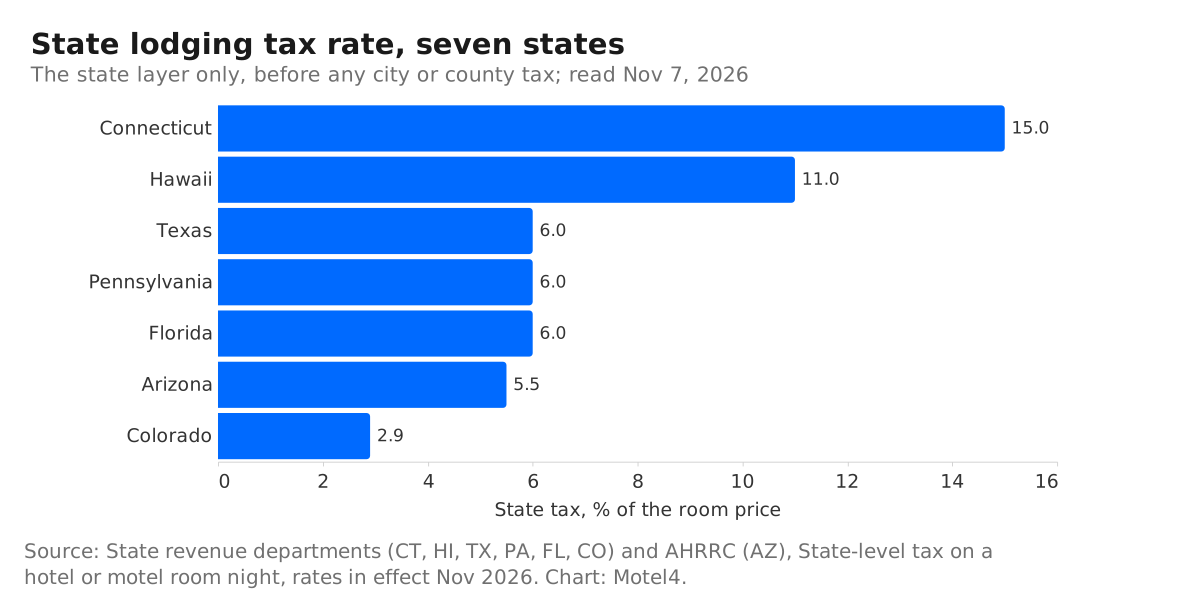
Connecticut taxes a motel room night at 15% before any other charge, the highest state rate among the seven states we checked on each state’s own pages [1]. Colorado’s state rate on the same night is 2.9% [2]. Texas, Pennsylvania and Florida all sit at 6% [3] [4] [5].
Most lists of occupancy tax by state stop at that state number, and for a small motel it is often the smaller part of the bill. The total, with county and city taxes added, is what a guest sees when comparing your price with the place across the county line, and it is what you remit.
The sections below chart the state layer, then use two official full tables, Arizona’s and Florida’s, to show what the local layer adds. If your front desk quotes prices on the phone, the total belongs in your hotel phone script templates as well as the nightly rate.
Occupancy tax by state: the state layer runs from 2.9% to 15%
Connecticut is highest of the seven at 15% for hotels, motels and lodging houses, with a lower 11% rate for bed and breakfasts [1]. Hawaii’s transient accommodations tax rose from 10.25% to 11.00% on January 1, 2026 [6]. Texas sets its state hotel occupancy tax at 6 percent of the cost of a room [3].
Pennsylvania charges hotel occupancy tax at the same 6 percent rate as its sales tax [4], and Florida adds its 6% state sales tax to transient rentals [5]. Arizona’s state rate on transient lodging is 5.5% in every community on its statewide table [7]. Colorado applies its 2.90% sales tax to rooms [2].
The long-stay rules differ more than the rates. Pennsylvania taxes rentals of less than 30 days [4]. Connecticut’s tax stops on the 31st consecutive day [1]. Colorado exempts a permanent resident only with a written agreement for at least 30 consecutive days [2]. Florida’s county taxes reach rentals of six months or less [5].
For a motel with weekly and monthly guests, that cutoff decides whether a long stay carries room tax at all, which matters for the weekly and monthly guest calls an extended-stay property fields. Texas also sets a floor: its state tax applies to rooms costing $15 or more a day, and local hotel taxes to rooms costing $2 or more [3].
Local taxes add more than the state in most of Arizona
In the median Arizona community, city and county lodging taxes add 7.1 points on top of the 5.5% state rate, so the local layer is larger than the state’s [7]. We counted that from the 98 rows of the Arizona Hospitality Research and Resource Center’s July 2026 table, which covers 91 communities; seven sit in two counties and appear twice.
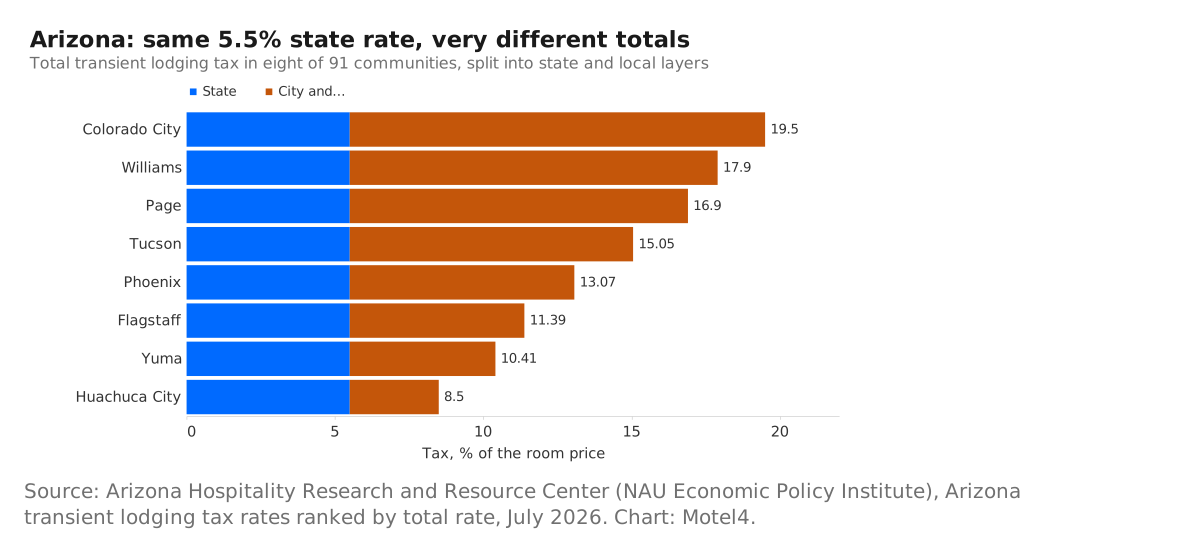
Totals run from 8.5% in Huachuca City to 19.5% in Colorado City, where the local layer alone is 14 points [7]. Phoenix totals 13.07% and Tucson 15.05% [7]. Depending on the town, the state’s share of the tax on an Arizona room night is between 28% and 65%.
On a $90 room night, a guest in Colorado City pays $9.90 more tax than a guest in Huachuca City, using the two totals above [7]. Two motels with the same posted rate can quote guests totals that far apart. The box below shows the inputs, so you can swap in your own rate and town.
Florida stacks the same way by county. Form DR-15TDT lists local option transient rental tax rates from 0% to 6% on top of the 6% state sales tax, with 7% in Miami Beach [5]. In 12 of Florida’s 67 counties the county rate is 6%, which doubles the state layer; five counties charge none.
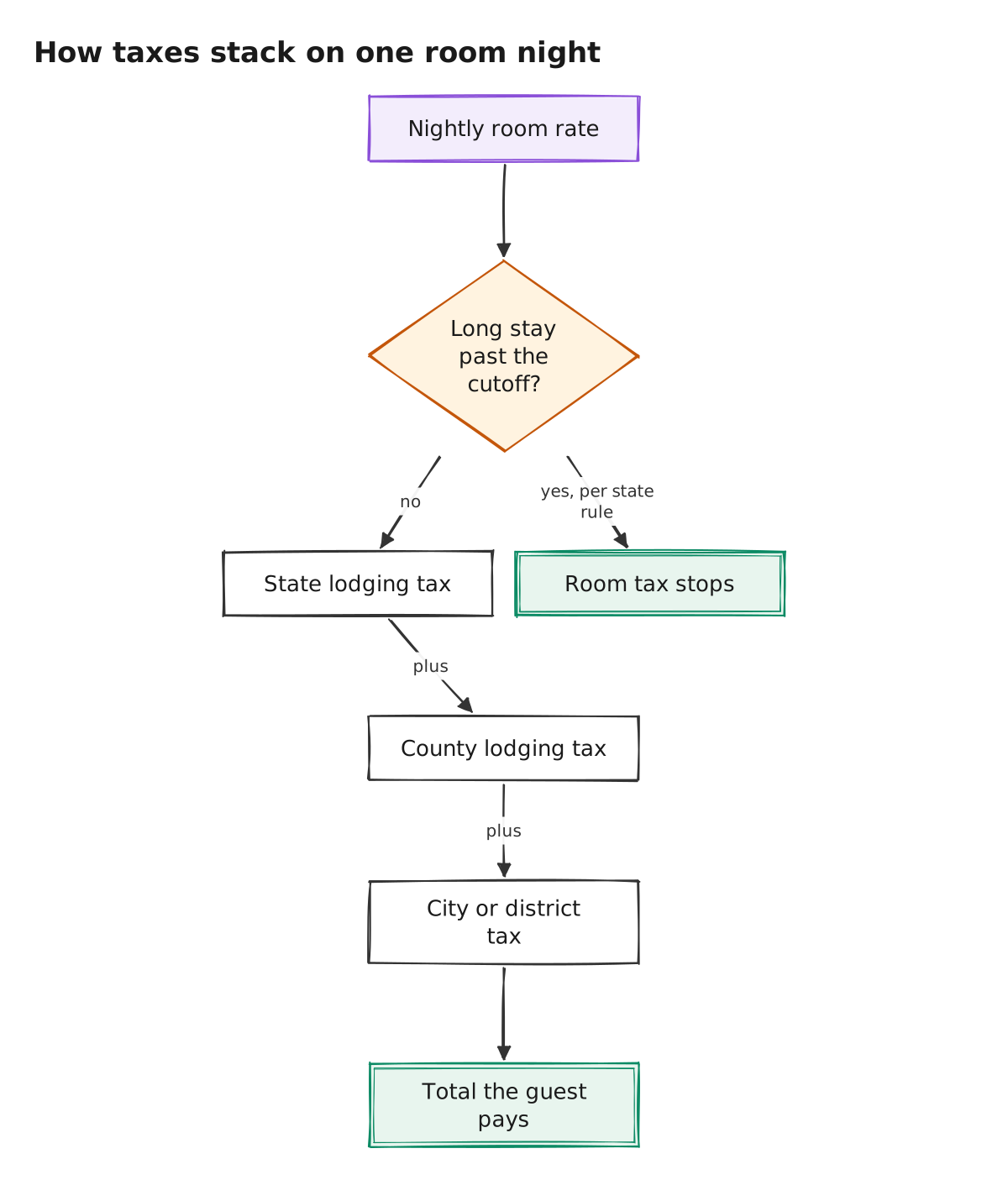
The diagram shows the order to check. First, is the stay past the long-stay cutoff? If not, add the state lodging tax, the county lodging tax, and any city or district tax to get the total the guest pays. In Colorado, counties and local marketing districts can each add a lodging tax [2].
How we built the table
On Nov 7, 2026 we read each state’s revenue department page or official notice: Connecticut’s Department of Revenue Services, Hawaii’s Announcement 2025-03, the Texas Comptroller, Pennsylvania’s Department of Revenue, Florida’s form DR-15TDT (revised October 2026), and a Colorado Department of Revenue fact sheet from June 2024.
For Arizona we used the table Northern Arizona University’s Economic Policy Institute publishes for the Arizona Hospitality Research and Resource Center, revised June 2026, because it lists city, county and state rates side by side [7]. We copied every rate into three data files published with this post.
A script checked that each Arizona row’s parts add up to its total and computed the medians and counts. Search demand for the query came from Google Keyword Planner, pulled the same day.
What the chart does not tell you
To be fair, seven states is a sample, not a national ranking. We kept states whose revenue department states the rate on a page we could open today; Massachusetts, New Hampshire and Rhode Island refused our requests, so they are missing. Each state figure is only the tax named on that page, and Texas cities, counties and special districts can add their own hotel tax [3].
We could not confirm combined city rates for Texas, Pennsylvania, Connecticut, Hawaii or Colorado from state sources. Florida’s form also warns that not all counties notify the state when they change their rate [5]. Before you quote a guest a total, confirm it with your city and county tax office.
Verdict
Use the state chart if you are comparing states before buying a property, because it shows the floor every room night carries and the long-stay rules that shape extended-stay income. Pick your combined city and county rate if you are setting or quoting a nightly price, because in Arizona the local layer runs from 3 to 14 points above the state’s 5.5% [7].
Connecticut’s 15% is the highest state number on the chart [1], yet a Colorado City motel collects 19.5% on the same room night [7]. When a guest asks what the room costs with tax, the answer is the total.
How we did this
Search demand from Google Keyword Planner (US, pulled Nov 7, 2026). Data from each state's revenue department (Connecticut, Hawaii, Texas, Pennsylvania, Florida, Colorado) and the Arizona Hospitality Research and Resource Center table (July 2026), all read Nov 7, 2026; the data files are published with this post. Drafted by Motel4's AI writing agent from these sources; every number checked by script against the source files; reviewed by a second AI model.
Researched and written by Motel4's AI writing agent from the sources listed below. Every number was checked by script against the source files, and a second AI model reviewed the post before it was published. The Motel4 Team is responsible for this page.
Sources
- Connecticut Department of Revenue Services, Room Occupancy Tax Information (primary source), accessed Nov 7, 2026.
- Colorado Department of Revenue, via the Colorado General Assembly, State and State-Administered Lodging Taxes (fact sheet, June 2024) (primary source), accessed Nov 7, 2026.
- Texas Comptroller of Public Accounts, Hotel Occupancy Tax (primary source), accessed Nov 7, 2026.
- Pennsylvania Department of Revenue, Sales, Use and Hotel Occupancy Tax (primary source), accessed Nov 7, 2026.
- Florida Department of Revenue, Form DR-15TDT, Local Option Transient Rental Tax Rates (R. 10/26) (primary source), accessed Nov 7, 2026.
- Hawaii Department of Taxation, Tax Announcement No. 2025-03, Transient Accommodations Tax Law Changes (primary source), accessed Nov 7, 2026.
- Arizona Hospitality Research and Resource Center, NAU Economic Policy Institute, Arizona Transient Lodging Tax Rates: Ranked by Total Rate, July 2026, accessed Nov 7, 2026.

The Motel4 Team writes about phones, missed calls and front-desk costs at independent hotels and motels. Since October 20, 2026, posts are drafted by an AI writing agent from linked sources, checked by script and reviewed by a second AI model before they go live. How we write. To reach us or report an error: motel4.ai/contact.