Hotel carbon monoxide detectors: 15 states name lodging in statute, and the model code decides placement
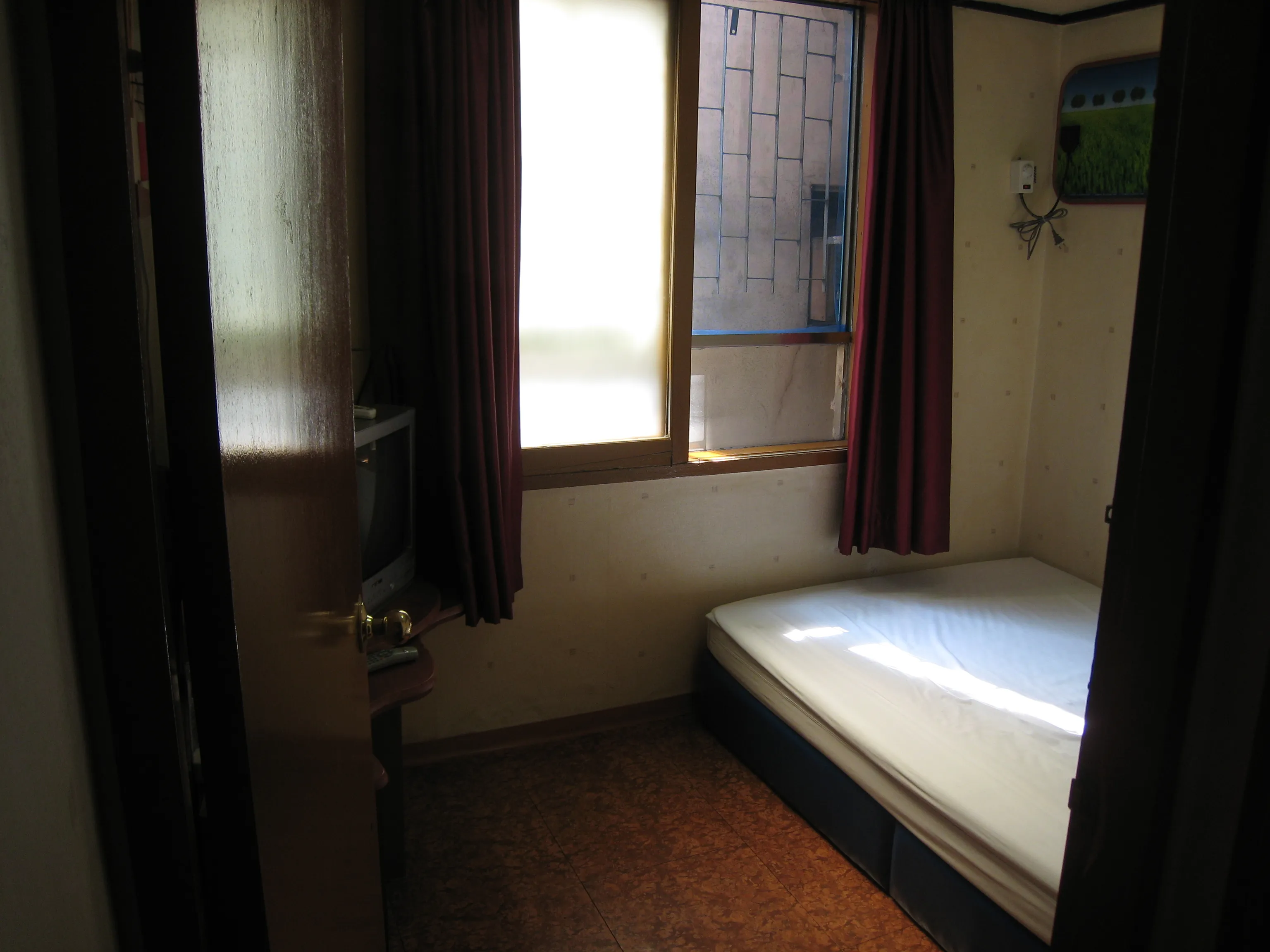

The National Conference of State Legislatures keeps the list most searches for carbon monoxide detectors in hotels end up citing, and its table marks 15 states with a statute for temporary lodging [1]. That answers whether your state has a hotel law. It does not tell you where the detector goes, and for a motel with a gas water heater, that is the expensive question.
Placement mostly comes from the fire or building code your state or city adopts, and NCSL says its own page “may not be reflective of all requirements” [1]. Get it wrong and you either miss a room that needed a detector or buy 40 when the code asked for one. The Consumer Product Safety Commission counts more than 200 deaths a year in the US from accidental non-fire CO poisoning tied to consumer products [2].
Which states require carbon monoxide detectors in hotels
Fifteen states have a row checked under temporary lodging in NCSL’s table, which was last updated September 29, 2025 [1]. The wording varies a lot. Some cover every room, some only new buildings, and some leave it to the fire marshal. Here is what NCSL’s summary says for each state, in its words or close to them.
| State | Statute NCSL cites | What NCSL’s summary says | Source |
|---|---|---|---|
| California | Health & Safety Code 17926 | CO device in hotel and motel dwelling units | [1] |
| Delaware | tit. 16, 6602C | Owners install CO devices in lodging establishments | [1] |
| Florida | Stat. 553.885 | New buildings since July 1, 2008 with fuel appliances: alarm within 10 feet of each sleeping room | [1] |
| Louisiana | Rev. Stat. 40:1563 | Fire marshal may require an alarm system in a hotel | [1] |
| Maine | tit. 25, 2468 | Hotels and inns must install detectors | [1] |
| Michigan | Comp. Laws 125.1504d | New hotels and motels: device where a fossil-fuel furnace, boiler or water heater is | [1] |
| Minnesota | Stat. 299F.51 | Alarm in each hotel guest room | [1] |
| Nevada | Rev. Stat. 244.35356 | Row checked; NCSL gives no summary | [1] |
| New Jersey | Stat. 55:13A-7.17 | Every hotel unit, unless no potential CO hazard | [1] |
| North Carolina | Gen. Stat. 143-138 | Electrical CO alarms at lodging establishments | [1] |
| Oregon | Rev. Stat. 455.360 | New or repaired hotels and motels | [1] |
| Tennessee | 68-120-101 and 68-120-112 | Within 10 feet of each sleeping room, hotels with a fuel source | [1] |
| Utah | Code 15A-5-204 | Follow the adopted International Fire Code | [1] |
| Vermont | tit. 20, 2729 | Hotels, motels and tourist homes | [1] |
| West Virginia | Code 15A-10-12 | Sleeping rooms next to, above and below rooms with fuel-burning appliances | [1] |
Florida has a second rule that NCSL lists without a lodging check: section 509.211 requires CO detectors in any boiler room of a public lodging establishment that also has sleeping rooms, wired into the property’s fire detection system [1]. If your boiler shares a building with guest rooms in Florida, that one applies too.
The model code puts the detector where the fuel burns
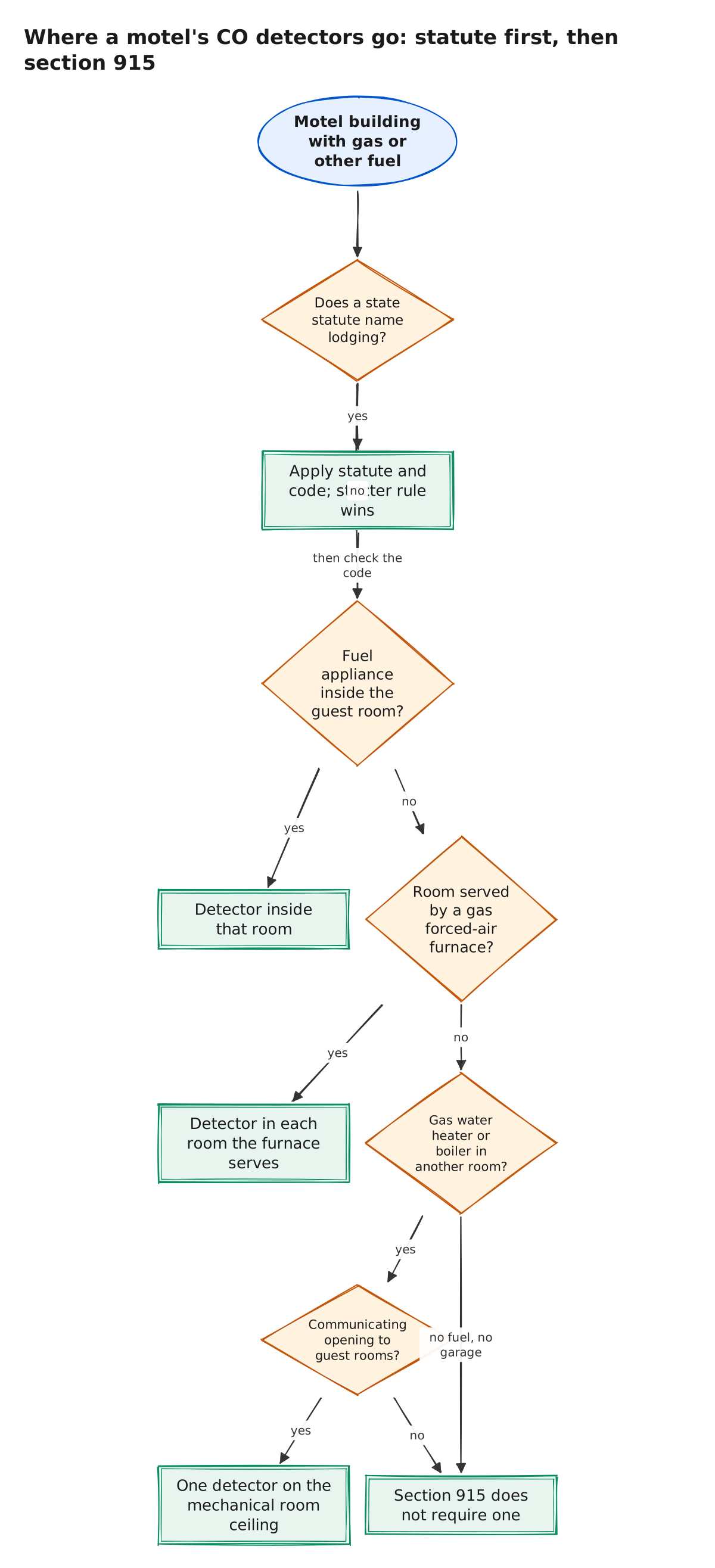
Section 915 of the model building and fire codes sorts a motel by where its fuel-burning equipment sits. We read it in Washington’s archived adoption, WAC 51-50-0915, which reproduces the full section; Washington changed only its first subsection [3]. Hotel rooms are “sleeping units” in this code.
- If a guest room contains a fuel-burning appliance or fireplace, such as a gas wall heater, the detector goes inside that room (915.1.2 and 915.2.2) [3].
- If a gas forced-air furnace serves the room, the detector goes in each room the furnace serves, unless one sits in the first room on each main duct and its alarm is sent automatically to an approved location (915.1.3) [3].
- If a gas water heater or boiler sits in another room of the building, every sleeping unit needs detection, with two exits (915.1.4) [3].
Those exits matter most to a typical motel. No detector is required where there is no communicating opening between the fuel-burning appliance and the room. Otherwise, one detector placed between the appliance and the rooms, or on the ceiling of the room holding the appliance, replaces the in-room detectors [3]. Attached private garages trigger detection too, except for rooms more than one story away (915.1.5) [3].
States edit this text. Minnesota’s version lets a room with no fuel appliance and no forced-air furnace have its detector outside the sleeping area, but within 10 feet of the room [4]. The model section also says existing buildings follow Chapter 11 of the fire code [3]. That is how an older motel ends up covered where a state or city adopted that chapter.
A 40-room motel can need one detector or 40
Take a 40-room motel with electric heat and air conditioning in every room and one gas boiler in a mechanical room that opens onto a corridor. Under the model code, the route on the diagram ends at “One detector on the mechanical room ceiling” [3]. Under Minnesota’s statute, the owner must install an alarm in each guest room used for sleeping, and replace any that go missing between stays [5].
That is 39 more devices under the Minnesota statute than under the model code exception. Both rules apply in Minnesota, so the stricter one wins. If that same mechanical room only opens to the outdoors, the model code may end at “Section 915 does not require one” for that boiler [3]. Your inspector decides what counts as a communicating opening, not the owner.
CPSC’s advice for homes points the same way for every room you do cover: battery-powered alarms or alarms with battery backup, placed outside sleeping areas, and interconnected so that when one sounds they all sound [2]. In a motel, the hard part is the 2 a.m. alarm in an occupied room, and who hears it.
What the statute table does not tell you
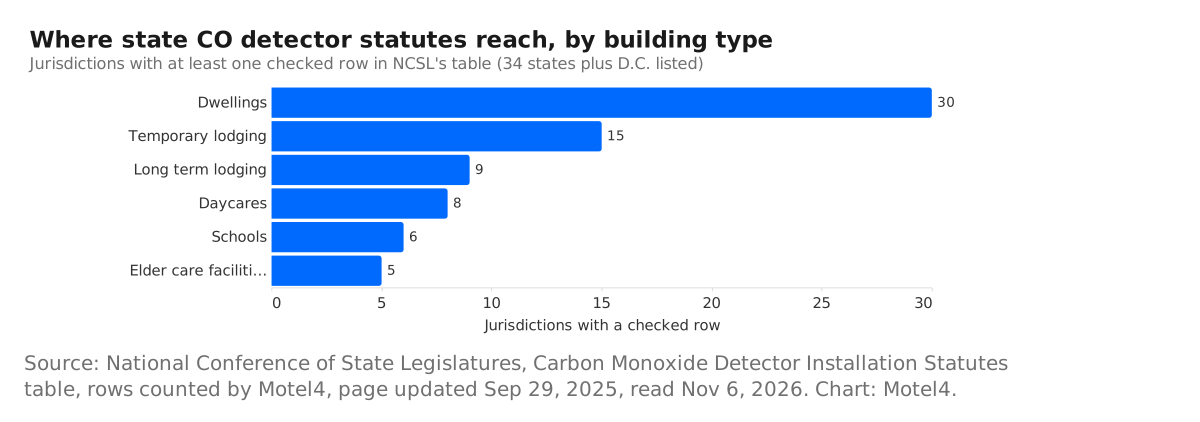
The table covers 35 jurisdictions, 34 states and D.C., and homes dominate it [1]. Counting rows per building type, 30 jurisdictions have a dwellings entry and 15 have a temporary lodging entry [1]. A state missing from the lodging list may still require hotel detectors through its adopted fire code; NCSL itself notes that requirements may come from statute, regulation or code [1].
We could not confirm which edition of the building or fire code each state or city enforces today, or whether it adopted Chapter 11 for existing buildings. The model text we quote is the older edition Washington used until July 1, 2023; newer editions reorganize section 915 [3]. This is not legal advice. Ask your local fire marshal or building department which edition applies and how they read “communicating opening.”
Verdict
Pick the in-room detector if any guest room has a gas heater, fireplace or other fuel appliance inside it, or is served by a gas forced-air furnace. Choose the single mechanical-room detector only if your state has no stricter statute and the inspector agrees your boiler or water heater room meets section 915.1.4’s exception. In Minnesota, put one in every guest room regardless [5].
Before the heating season, walk the property with this list: every fuel appliance, which rooms it can reach, and your state’s row in the NCSL table [1]. Then ask the fire marshal one question about openings. We explain how we sourced this in how we write.
How we did this
Search demand from Google Keyword Planner (US, pulled Nov 6, 2026). State statutes from NCSL's carbon monoxide detector table (updated Sep 29, 2025), parsed and counted by script on Nov 6, 2026. Model code section 915 text from Washington's archived adoption, WAC 51-50-0915; Minnesota rule 7511.0915 and statute 299F.51 read on the Minnesota Revisor's site. Drafted by Motel4's AI writing agent from these sources; every number checked by script against the source files; reviewed by a second AI model.
Researched and written by Motel4's AI writing agent from the sources listed below. Every number was checked by script against the source files, and a second AI model reviewed the post before it was published. The Motel4 Team is responsible for this page.
Sources
- National Conference of State Legislatures, Carbon Monoxide Detector Installation Statutes, accessed Nov 6, 2026.
- U.S. Consumer Product Safety Commission, Carbon Monoxide Information Center (primary source), accessed Nov 6, 2026.
- Washington State Legislature, WAC 51-50-0915, Section 915 Carbon monoxide detection (archived text, effective until July 1, 2023) (primary source), accessed Nov 6, 2026.
- Minnesota Office of the Revisor of Statutes, Minnesota Rules 7511.0915, Section 915 Carbon monoxide detection (primary source), accessed Nov 6, 2026.
- Minnesota Office of the Revisor of Statutes, Minnesota Statutes 299F.51, Requirements for carbon monoxide alarms (primary source), accessed Nov 6, 2026.

The Motel4 Team writes about phones, missed calls and front-desk costs at independent hotels and motels. Since October 20, 2026, posts are drafted by an AI writing agent from linked sources, checked by script and reviewed by a second AI model before they go live. How we write. To reach us or report an error: motel4.ai/contact.