A pet stay costs a small motel about $21 to clean up after, so build the pet fee from that
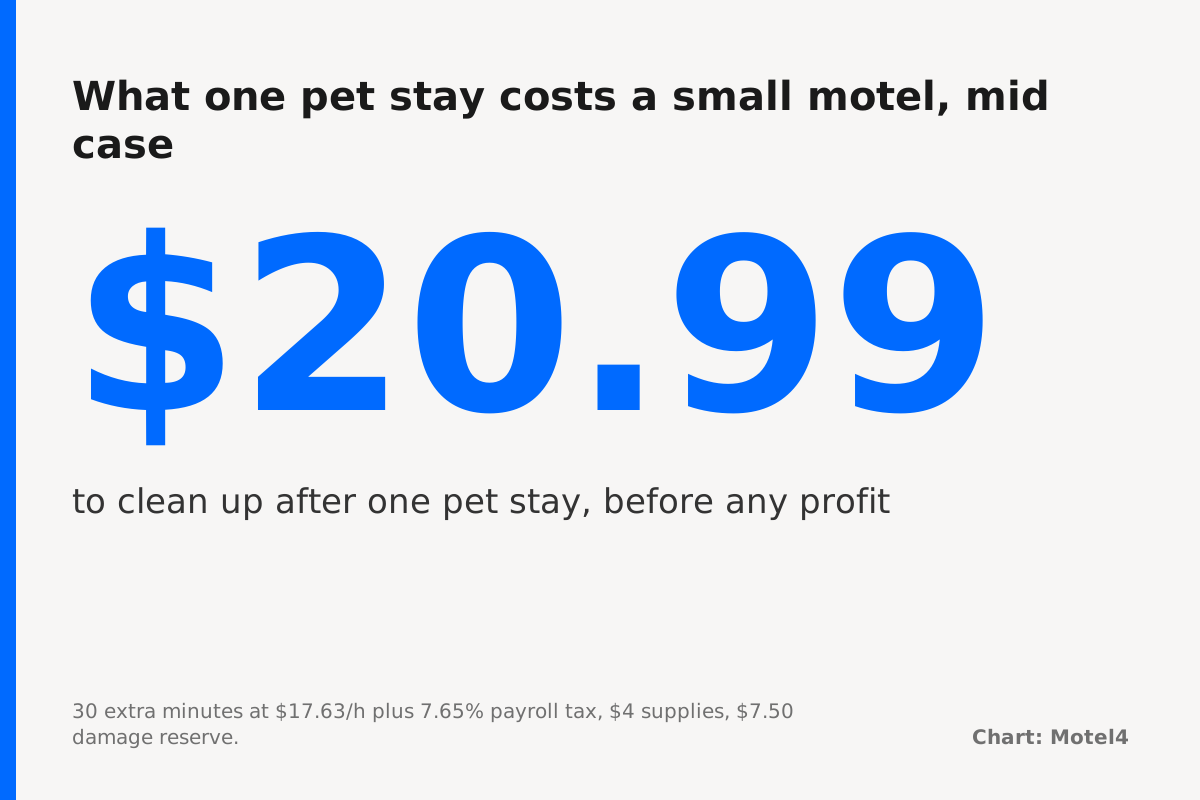
Housekeepers at hotels and motels earned a mean of $17.63 an hour in May 2025, according to the Bureau of Labor Statistics wage survey [1]. That wage, multiplied by the extra minutes a room takes after a dog or cat checks out, is the floor under any hotel pet fee that is meant to pay for itself.
Most fee advice starts from what other properties charge. We started from cost instead: housekeeping time, supplies and a reserve for damage. At our mid case, one pet stay costs a small motel $20.99 before any profit, and the range runs from $8.49 to $57.22 depending on your wage and your rooms.
The math below covers one pet stay at a small independent motel. It does not survey what competitors charge, and it does not cover the extra nights a deep-cleaned room might sit empty. It does cover the one guest you may not charge at all, which is where owners get the fee most wrong.
A pet stay costs about $21 at the mid case
Thirty extra housekeeping minutes at $17.63 an hour [1], plus the employer’s 7.65% payroll tax [2], comes to $9.49 of labor. Add $4 of supplies and a $7.50 damage reserve, and the total is $20.99 per stay.
Call it about $21. Only two inputs come from a source: the wage and the tax rate. The other four are our assumptions, written down so you can swap in your own and see the number move.
Labor is the part you can check against BLS wages
The wage is the mean for maids and housekeeping cleaners in traveler accommodation, the BLS industry that holds hotels and motels, from the May 2025 estimates [1]. The same survey puts the 10th percentile at $12.95, the median at $16.79 and the 90th percentile at $23.80 an hour, so a rural motel and a resort-town motel can sit far apart.
The tax rate is what the employer owes on every wage dollar for 2026: 6.2% for social security and 1.45% for Medicare, according to IRS Publication 15 [2]. State unemployment tax and workers’ compensation would add more, so treat 7.65% as the floor on payroll cost.
The minutes are yours to time. Thirty extra minutes covers vacuuming hair from carpet and under beds, lint-rolling the chair and bedspread, and checking for stains and smell. If your housekeeper finishes a pet room in 15 extra minutes, labor falls to $3.49 at the low-end wage.
Supplies and damage are your numbers, so replace ours
Supplies at $4 a stay assume a few lint roller sheets, enzyme cleaner for one spot, an extra laundry load for a blanket and vacuum filter wear. We did not price these from a vendor, so check your own receipts for a month and divide by the pet stays you had.
The damage reserve is the input that swings hardest. We assumed 5% of pet stays leave $150 of damage you never bill, which works out to $7.50 a stay. A chewed door frame or a stained mattress can cost far more, which is why the high case uses 10% and $300, a reserve of $30.00.
Charge the fee per stay, since most of the cleaning happens once, at checkout. A $21 per-night fee on a three-night stay collects $63 for one cleaning job. That gap is the kind of thing a guest notices and writes about in a review.
The hotel pet fee you need ranges from $8.49 to $57.22 a stay
Your fee needs to cover your own cost line. The table shows three cases, with the wage, minutes, supplies and damage moving together from cheap to expensive.
| Case | Wage | Extra minutes | Supplies | Damage reserve | Cost per stay |
|---|---|---|---|---|---|
| Low | $12.95 | 15 | $2 | 2% x $150 = $3.00 | $8.49 |
| Mid | $17.63 | 30 | $4 | 5% x $150 = $7.50 | $20.99 |
| High | $23.80 | 45 | $8 | 10% x $300 = $30.00 | $57.22 |
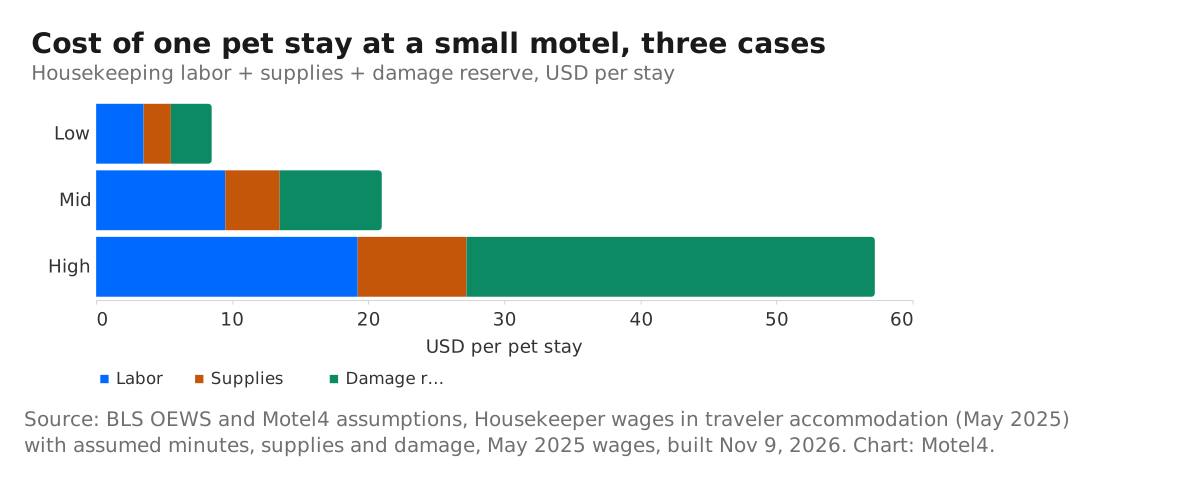
A $25 per-stay fee leaves about $4.01 of margin at the mid case. At the high case the same $25 falls $32.22 short, and most of that gap is damage, so a high-wage property with carpeted rooms either charges more or moves pets to hard-floor rooms.
This assumes every pet stay gets the same extra cleaning and that damage you do bill to the guest is left out of the reserve. It also leaves out rooms held back for allergy cleaning. If you already bill damage reliably, shrink the reserve and your fee can drop.
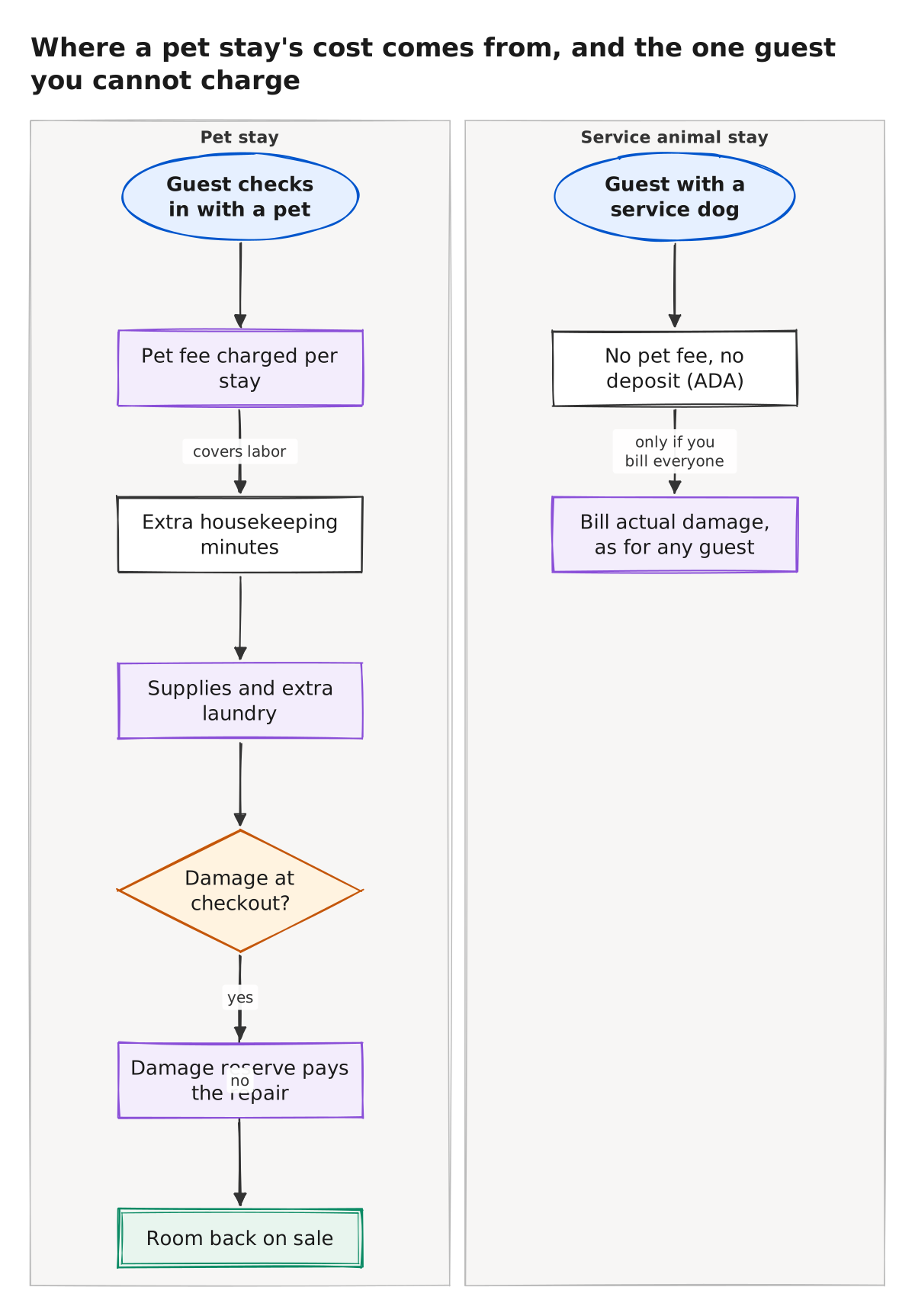
Service animals pay no pet fee, but damage is still billable
The Justice Department’s ADA guidance is plain: “if a business requires a deposit or fee to be paid by patrons with pets, it must waive the charge for service animals” [3]. That means no pet fee and no pet deposit for a guest with a service dog, even though the room may need the same 30 minutes.
The same page allows one thing owners often miss: if a hotel normally charges guests for damage they cause, a guest with a disability “may also be charged for damage caused by himself or his service animal” [3]. Bill actual damage, as for any guest, and keep the pet fee off the folio.
When the need is not obvious, your desk may ask two questions: is the dog required because of a disability, and what task is it trained to do [3]. Staff cannot demand papers or an ID card. Dogs kept only for emotional support do not qualify under the ADA, though some state laws are broader [3].
The cost of service dog stays still lands somewhere, so fold it into the room rate across all guests instead of a fee. If your night clerk or phone line gives callers mixed answers on this, make every caller hear the same written pet policy.
Verdict
Pick a per-stay pet fee at or a little above your own cost line if your number lands near the mid case of $20.99, and write the service dog exemption into the same policy. Choose a higher fee, or pet rooms with hard floors, if your wage sits near the 90th percentile of $23.80 and you rarely bill damage.
Start with the $17.63 BLS wage [1], then replace it with your own payroll rate and time one pet room this week. Those two numbers set most of the fee, and you can check both yourself.
How we did this
Search demand from Google Keyword Planner (US, pulled Nov 9, 2026). Housekeeper wages from the BLS Occupational Employment and Wage Statistics, May 2025, read from the BLS public API on Nov 9, 2026. Employer payroll tax rates from IRS Publication 15 (2026), checked Nov 9, 2026. Service animal rules from the Justice Department's ADA guidance, checked Nov 9, 2026. Cleaning minutes, supplies and damage figures are stated assumptions. Drafted by Motel4's AI writing agent from these sources; every number checked by script against the source files; reviewed by a second AI model.
Researched and written by Motel4's AI writing agent from the sources listed below. Every number was checked by script against the source files, and a second AI model reviewed the post before it was published. The Motel4 Team is responsible for this page.
Sources
- U.S. Bureau of Labor Statistics, OEWS May 2025, maids and housekeeping cleaners (37-2012), traveler accommodation (721100), hourly mean wage (primary source), accessed Nov 9, 2026.
- Internal Revenue Service, Publication 15 (2026), Employer's Tax Guide (primary source), accessed Nov 9, 2026.
- U.S. Department of Justice, Civil Rights Division, ADA Requirements: Service Animals (primary source), accessed Nov 9, 2026.

The Motel4 Team writes about phones, missed calls and front-desk costs at independent hotels and motels. Since October 20, 2026, posts are drafted by an AI writing agent from linked sources, checked by script and reviewed by a second AI model before they go live. How we write. To reach us or report an error: motel4.ai/contact.