Rate parity in the US: Booking.com's terms cover your phone rate, and only repeat members are exempt

Booking.com’s General Delivery Terms sort every country into one of three rate parity regimes: narrow, none, or wide [1]. The narrow list names 12 jurisdictions, including Australia, Japan and the United Kingdom. The no-parity list covers the European Economic Area plus Chile, Indonesia, Russia, South Africa and Switzerland. Everything else is wide parity [1]. The United States is on neither named list.
That matters because most of what owners read about rate parity describes Europe. The European Commission designated Booking as a gatekeeper under the Digital Markets Act on May 13, 2024 [2], and Booking.com has had to comply since Nov 14, 2024, with parity requirements removed from its terms for properties in the EEA [3]. A 30-room motel in Ohio signs the same document under different rules.
About 170 people a month search Google for “rate parity” in the US, according to our Keyword Planner pull; this post reads the clauses they are asking about.
Rate parity in the US covers your phone and front-desk rates
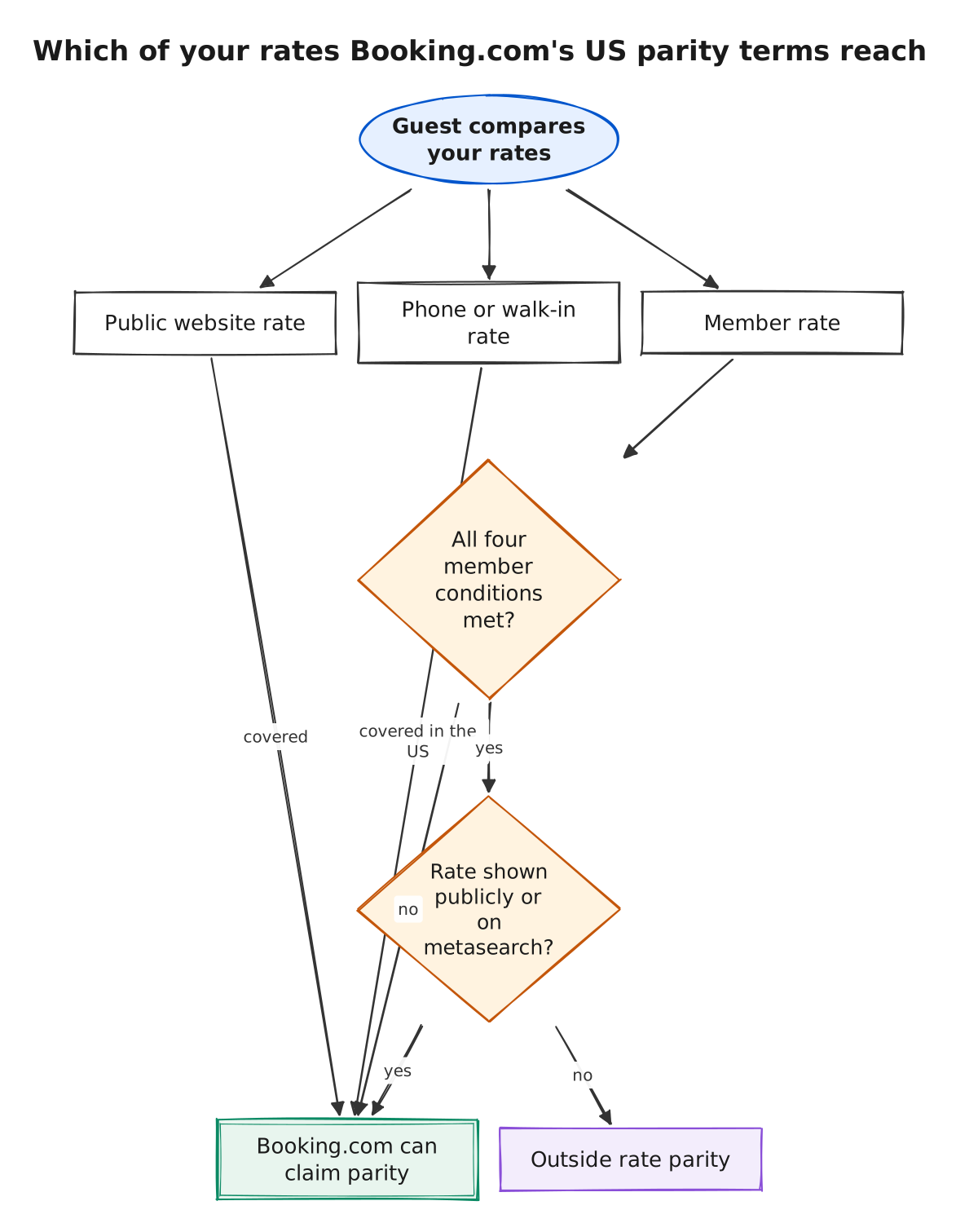
For a US property, Annex 5 of the terms decides what parity means, and it reaches the phone. The annex applies “to the extent that the Accommodation (meaning property) is located in a Wide Parity Country”, and its new clause 2.2.1 “shall replace Clauses 2.2.1 and 2.2.2” of the main terms [1].
That replacement is the detail most summaries miss. Clause 2.2.2 of the main terms is where the friendly carve-outs live: rates offered “by telephoning the Accommodation” or at reception, as long as they are not published or marketed online, and rates that are unpublished [1]. Narrow-parity properties keep those carve-outs. Under Annex 5, a US property does not [1].
Annex 5 instead defines rate parity as the same or better rates for the same room type, dates, bed type and guest count as are available “on the Accommodation’s websites, apps or call-centres (including the customer reservation system), or directly at the Accommodation” [1]. It also covers competitors of Booking.com, online or offline, and any business partner of the property [1].
Two more details close the usual workarounds. Parity covers “the same or better amenities and add-ons (e.g. free breakfast, wifi, early/late check-out)” and the same or better cancellation and change policies [1]. So a direct rate with free breakfast, or a cheaper rate with looser cancellation, is in scope too.
A phone or walk-in rate below Booking.com is covered as well, so a quote given on a Booking.com guest’s phone call falls under the same rule [1].
The closed user group is the one written exception
The exception that remains is narrow and specific. Annex 5 says rate parity “does not apply in respect of rates intended for a closed user group” [1]. To count, the group needs defined limits, membership that is not automatic, and all four of these conditions [1]:
- Guests actively opt in to become members.
- Any online or mobile page members use is password protected.
- Members have completed a customer profile.
- The guest offered the rate has already made at least one prior booking as a member.
The fourth condition is the one that changes the plan. A “join now and save” box on your booking page fails it, because the first booking is made before the guest has a member booking behind them [1]. Read plainly, the exception covers your repeat guests, not first-time shoppers. The member rate is a loyalty tool, not a way to beat Booking.com for a new guest.
The exception also ends the moment the rate leaks. If a closed user group rate becomes publicly available, whether through you, an OTA or “any (meta) search engine or price comparison website”, Booking.com “is entitled to Rate Parity for such rate” [1]. Elsewhere the terms treat showing “xx% off” as publishing a rate [1], so the cautious move is to keep the member price, and the size of the discount, behind the login.
A member rate pays only when it moves a booking off the OTA
The member rate costs you money on any guest who would have booked direct anyway. It earns money only on a stay that would otherwise have come through Booking.com, and only while your member discount is smaller than the commission you avoid. Booking.com’s terms say the commission percentage is “as set out in the Agreement” [1], so check yours in the extranet before you pick a discount.
With the inputs above, all of them assumptions you should replace with your own, a repeat-guest member rate 10% below a $110 public rate, against a 15% commission, keeps about $165 a month across 30 shifted room-nights. That is the gap between commission and discount, times the revenue moved. If the discount equals or exceeds your commission, the program loses money on every shifted stay.
This is also where a phone line earns its keep, though the phone rate itself is not exempt. Treat the call as the moment to sign a returning guest up for the member program at the public rate. The discount applies from the next stay, which is when the fourth condition is met.
What happens if a guest finds a lower rate
The terms spell out the remedy, and it lands at checkout. Under the We Price Match clause, when Booking.com is entitled to parity and a guest has a valid claim, the property must lower its Booking.com rate for future bookings, adjust that guest’s reservation, and at checkout either charge the lower rate or “refund (in cash) the Guest the difference” [1].
Breach of parity is also listed as a ground for immediate termination or suspension in wide-parity countries [1].
The terms also let Booking.com cut your price at its own expense. Clause 2.2.4 says Booking.com “may give an incentive with respect to the Room Price at its own cost” and pay part of the room price for the guest [1]. In the EEA the Commission describes the same mechanism, Booking Sponsored Benefit, as leaving the hotel paid in full at the rate it set [3].
We could not confirm how other OTAs word parity: we found no published copy of Expedia’s lodging partner agreement and read none, so nothing here describes it.
We also read the public terms page, not your signed contract, and Booking.com can move a country between lists “from time to time” [1]. This is our reading of the text, not legal advice; for a dispute, ask a lawyer with your Agreement in hand.
Verdict
Pick a closed member rate if you have repeat guests and can put the price behind a password-protected login that only past member bookers see. Keep your public website, phone and walk-in rates at or above Booking.com if your property is in the US and you sell there, because Annex 5 covers all three [1]. Skip “join and save” pop-ups if your goal is beating Booking.com on a first booking.
The rule may still move. The Commission’s factsheet says Booking.com plans another update to its terms, on ranking, later this year [3]. Before you change a rate, open the General Delivery Terms again, find the country lists, and read Annex 5 for yourself [1].
How we did this
Search demand from Google Keyword Planner (US, pulled Nov 3, 2026). Contract wording read from Booking.com's General Delivery Terms and the European Commission's Digital Markets Act pages on Nov 3, 2026; the clause excerpts we used are saved with this post. Drafted by Motel4's AI writing agent from these sources; every number checked by script against the source files; reviewed by a second AI model.
Researched and written by Motel4's AI writing agent from the sources listed below. Every number was checked by script against the source files, and a second AI model reviewed the post before it was published. The Motel4 Team is responsible for this page.
Sources
- Booking.com, General Delivery Terms (accommodation partner terms, including Annex 5, Wide Parity) (primary source), accessed Nov 3, 2026.
- European Commission, Gatekeepers portal: Booking designated under the Digital Markets Act (primary source), accessed Nov 3, 2026.
- European Commission, Factsheet: how the DMA ensures businesses using Booking.com are free to set their prices on and off Booking.com (Sep 28, 2026) (primary source), accessed Nov 3, 2026.
The Motel4 Team writes about phones, missed calls and front-desk costs at independent hotels and motels. Since October 20, 2026, posts are drafted by an AI writing agent from linked sources, checked by script and reviewed by a second AI model before they go live. How we write. To reach us or report an error: motel4.ai/contact.