Early check-in and late checkout fees: about $9,100 a year for a 30-room motel, if housekeeping keeps up
The Toledo Town Inn’s policies page lists check-in at 1 pm with a “$20 early check in fee”, checkout at 11 am with a “$10 per hour late check out fee”, and a waiver for guests who ask 48 hours ahead when rooms are open [1]. Two small fees, posted in plain sight. This post works out what they add up to in a year, and what they cost in housekeeping time.
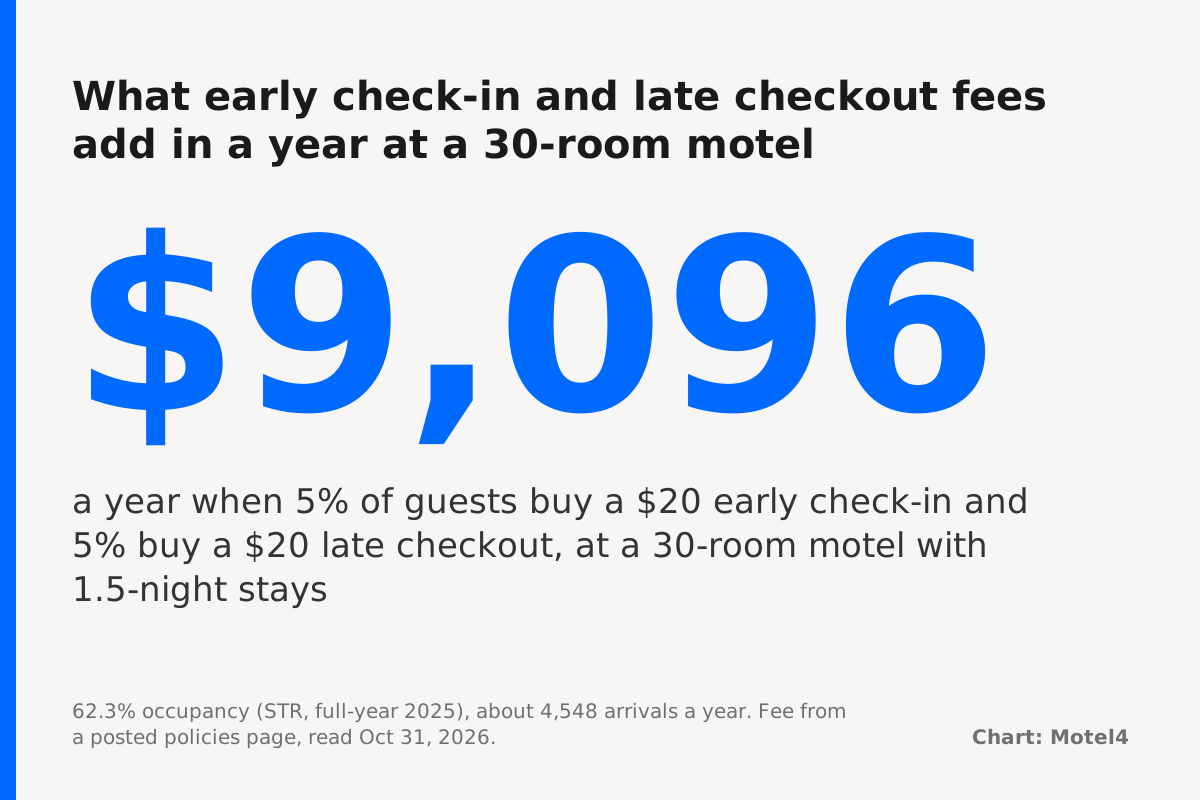
At a 30-room motel running the 2025 US average occupancy of 62.3% [2], with 1.5-night stays, a $20 early check-in and a $20 late checkout bring in about $9,100 a year if 5% of guests buy each one. At 2% it is about $3,640, at 10% about $18,200. Both fees can stay out of your advertised rate under the FTC’s fee rule, which shapes how you quote them.
The math covers one property for one year at three take-up rates. It leaves out the room-night you lose when an 8 am arrival needs a room held empty the night before, and any fee you waive for regulars. Every input sits in the evidence files, which is how we write every post.
Most people searching for an early check in fee are travelers checking whether they will be charged. In our Keyword Planner pull of Oct 31, 2026, the phrase drew 210 US searches a month on average, 110 in January and 390 in August 2026. The owner’s question, what to charge and when to say yes, gets less attention. That is what follows.
About $9,100 a year at 5% take-up for a 30-room motel
Arrivals are the unit, because every arrival can buy an early check-in and every departure a late checkout. Thirty rooms at 62.3% occupancy sell about 6,822 room-nights a year, and at 1.5 nights a stay that is about 4,548 arrivals. Five percent of them is 227 requests a year for each service, or four or five a week each.
The formula gives $9,096 a year, call it $9,100, or about $758 a month. The fee is the same $20 either way, so the number moves with how many guests say yes and whether the desk offers it at all.
Where the $20 comes from: two posted fee schedules
The $20 is a posted price rather than a guess. The Toledo Town Inn charges $20 for a 1 pm check-in and $10 for every hour past its 11 am checkout, so a 1 pm departure costs the same $20, and it waives both fees with 48 hours’ notice when rooms are open [1].
The TWA Hotel posts a steeper ladder. Early check-in between 12 pm and 2 pm is $25, but between 8 am and 12 pm it is $75. Late checkout starts at $50 for 2 pm and rises by $25 an hour to $150 for 6 pm, and the hotel refunds the fee when it cannot accommodate the request [3].
The shape of that ladder is the useful part: the price climbs with the housekeeping pain. A noon arrival takes a room that was probably cleaned yesterday. An 8 am arrival needs a room that sat empty all night, a room-night you could have sold. A 6 pm departure means a room cleaned after the day shift has gone home.
Late checkouts cost housekeeping time, early check-ins usually do not
On an average night a 30-room motel at 62.3% occupancy has about 19 rooms occupied and 11 vacant. An early check-in at 1 pm can go into a vacant room from last night, cleaned the day before, so most days it carries no cleaning cost. Only on a sold-out night does it pull a room out of the cleaning queue.
A late checkout is different. Checkout at 11 am and check-in at 3 pm give housekeeping a four-hour window for each departing room. Let a guest stay to 1 pm and the cleaning window shrinks to two hours for that room. If a housekeeper is free, you get a room ready for the 3 pm arrival. If not, the choice is overtime or a room not ready.
Price that against the wage. The median hourly wage for maids and housekeeping cleaners was $17.07 in the 2025 BLS data, as published by O*NET, the Labor Department’s occupation database [4]. A 30-minute departure clean costs $8.54 at straight time and $12.80 at time and a half. A $20 late checkout nets the full $20 inside the shift and about $7.20 in overtime.
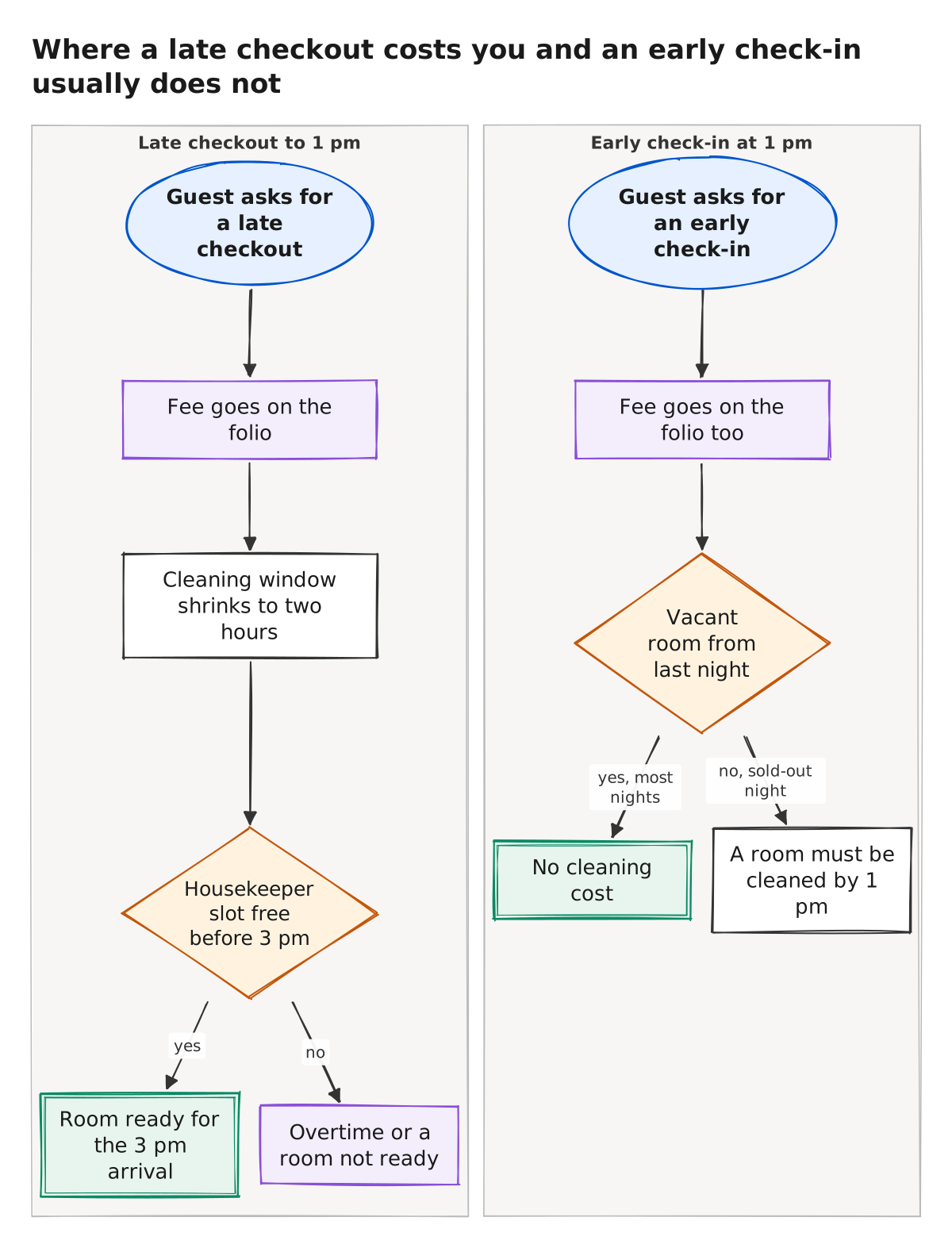
The practical limit is housekeeper slots rather than dollars. At 30 minutes a room, one housekeeper turns about four rooms between 1 pm and 3 pm. That is the most 1 pm late checkouts you can sell per housekeeper on shift, provided the other departures are done by 1 pm. Each early check-in granted on a sold-out day takes one of those slots.
| Housekeepers on shift | Rooms turned between 1 pm and 3 pm | Late checkouts to 1 pm you can sell without overtime |
|---|---|---|
| 1 | 4 | 4, minus early check-ins granted that day |
| 2 | 8 | 8, minus early check-ins granted that day |
| 3 | 12 | 12, minus early check-ins granted that day |
On an average day the house has about 12 departures and six stayovers, roughly 7.8 housekeeper-hours at 30 minutes a departure and 15 minutes a stayover. One housekeeper is already a full shift. A 30-room motel that wants to sell late checkouts needs a second person on turnover days, or a rule that late checkouts stop when the count is reached.
The Toledo Town Inn’s waiver is a scheduling tool wearing a fee’s clothes. Asking for 48 hours’ notice lets housekeeping put that room last on the list, so the inn gives the time away when it is free and charges when it is not [1].
The FTC fee rule lets you keep these fees out of the room rate, on two conditions
The Federal Trade Commission’s Rule on Unfair or Deceptive Fees has covered short-term lodging since May 12, 2025, and it applies to any business that “offers, displays, or advertises” such lodging [5]. Its core demand is that a business may not advertise any price “without clearly and conspicuously disclosing the total price”, with every mandatory fee included [6].
Early check-in and late checkout fees sit outside that total, on one condition. Businesses “may only exclude three categories of charges from the total price: government charges, shipping charges, and fees or charges for optional ancillary goods or services that people choose to add to the transaction” [5].
A late checkout a guest asks for is exactly that. A fee added to every booking is mandatory, and the rule’s definition of total price includes “any mandatory ancillary good or service” [7].
The condition is disclosure before the guest pays. Before the consumer consents to pay, the business must disclose “the nature, purpose, and amount of any fee or charge imposed on the transaction that has been excluded from total price”, plus the final amount of payment [6].
On the phone that means saying the amount out loud. The rule’s definition of a clear disclosure covers “an audible disclosure, including by telephone or streaming video” and requires a “volume, speed, and cadence sufficient for ordinary consumers to easily hear and understand it” [7].
The second condition is honesty about the fee itself. Section 464.3 makes it a violation to misrepresent “the nature, purpose, amount, or refundability of any fee or charge” [8]. Call it what it is, charge the posted amount, and if you say the fee comes back when you cannot deliver the early room, refund it. Put it in your desk scripts, such as our hotel phone script templates.
One grey area remains: the guest who never asks and simply leaves at 1 pm. The FAQ’s examples of charges that can be left out of the total and billed later are fees “for late payment or charges for damage to a hotel room” [5]. An overstay charge is closest to that group. You are safest when the per-hour amount is on the registration card the guest signed. This is not legal advice.
Motel4 sells an AI phone receptionist that answers from the information a property gives it. If you charge these fees, load the amounts and the conditions, so a caller at 11 pm hears the same $20 the website shows. Our earlier post on handling late check-in calls covers the arrival-time questions that come in after hours.
How the result moves: 2%, 5% and 10% take-up
Take-up is the input you control least and know least, so the table holds everything else fixed and moves only that. Two guests in a hundred buying each service is a desk that never offers. One in ten is a desk that mentions it at every check-in and every checkout.
| Case | Share of guests who buy each service | Requests a year, each service | Fee revenue a year | A month |
|---|---|---|---|---|
| Low | 2% | 91 | $3,638 | $303 |
| Mid | 5% | 227 | $9,096 | $758 |
| High | 10% | 455 | $18,192 | $1,516 |
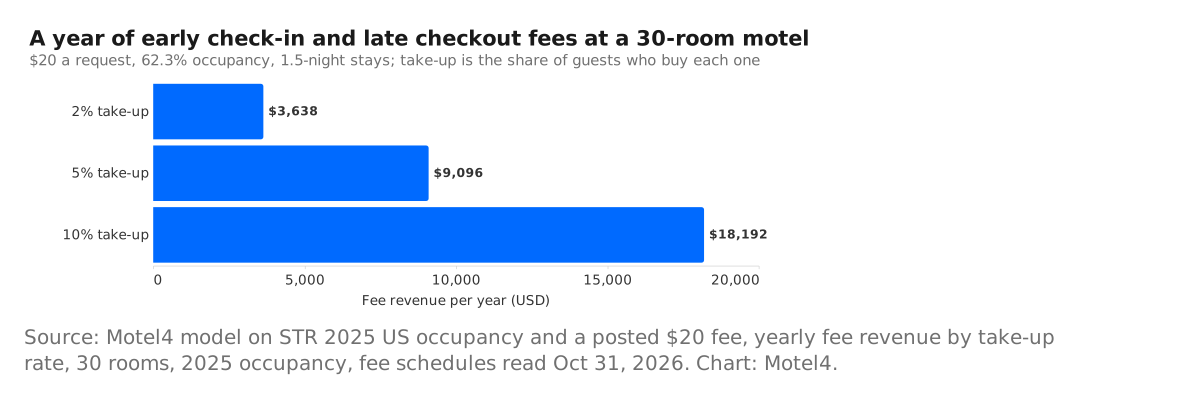
Two things move the number more than the fee level. Sold-out nights cut early check-ins, because no vacant room from last night is waiting. Short stays raise it, because a motel full of one-night guests has more arrivals per occupied room than one with weekly guests at the same occupancy.
This assumes the 2025 national occupancy of 62.3% [2], 1.5-night stays and a flat $20 for either service, with no lost room-night for very early arrivals and no fee waived for repeat guests. A highway motel full of one-night stays will see more arrivals than this, a weekly-rate property far fewer. Run the formula with your own arrivals from last year’s folios before you set the fee.
Verdict
Sell early check-in on any night you are not sold out, and charge for it, because a vacant room from last night costs you nothing to hand over at 1 pm. Charge for late checkout too, but cap what you sell at four per housekeeper on shift, and stop when the count is reached.
Skip the late checkout fee if you run one housekeeper and 12 departures a day, since every 1 pm room already lands in overtime. Choose a per-hour fee like the Toledo Town Inn’s $10 if you want the price to climb with the pain, and a flat $20 if you want a number the desk and the phone can say in one breath.
Either way, post the amount, say it on the phone, and keep it out of the nightly rate you advertise. The Toledo Town Inn does all three in two lines of its policies page [1], and $9,100 a year is roughly what those two lines are worth at 30 rooms and 5% take-up.
How we did this
Search demand from Google Keyword Planner (US, pulled Oct 31, 2026). Occupancy from CoStar/STR's full-year 2025 US release of Jan 20, 2026; fee schedules from the Toledo Town Inn and TWA Hotel policy pages; housekeeping wage from O*NET's 2025 BLS wage data; the FTC fee rule from the FTC's FAQ and 16 CFR Part 464 as published by Cornell's Legal Information Institute, all read Oct 31, 2026. Yearly revenue and housekeeping capacity computed in the evidence file fee-model.json. Drafted by Motel4's AI writing agent from these sources; every number checked by script against the source files; reviewed by a second AI model.
Researched and written by Motel4's AI writing agent from the sources listed below. Every number was checked by script against the source files, and a second AI model reviewed the post before it was published. The Motel4 Team is responsible for this page.
Sources
- Toledo Town Inn, Policies (check-in, check-out, early check in and late check out fees) (primary source), accessed Oct 31, 2026.
- CoStar Group, STR, U.S. hotels report first full-year occupancy, RevPAR declines since 2020 (full-year 2025 results), accessed Oct 31, 2026.
- TWA Hotel, Hotel FAQs (check-in, checkout, early check-in and late check-out fees) (primary source), accessed Oct 31, 2026.
- O*NET OnLine, U.S. Department of Labor, 37-2012.00 Maids and Housekeeping Cleaners, wages and employment trends (BLS 2025 wage data) (primary source), accessed Oct 31, 2026.
- Federal Trade Commission, The Rule on Unfair or Deceptive Fees: Frequently Asked Questions (primary source), accessed Oct 31, 2026.
- Legal Information Institute, Cornell Law School, 16 CFR 464.2 Hidden fees prohibited (primary source), accessed Oct 31, 2026.
- Legal Information Institute, Cornell Law School, 16 CFR 464.1 Definitions (primary source), accessed Oct 31, 2026.
- Legal Information Institute, Cornell Law School, 16 CFR 464.3 Misleading fees prohibited (primary source), accessed Oct 31, 2026.

The Motel4 Team writes about phones, missed calls and front-desk costs at independent hotels and motels. Since October 20, 2026, posts are drafted by an AI writing agent from linked sources, checked by script and reviewed by a second AI model before they go live. How we write. To reach us or report an error: motel4.ai/contact.