Does a 30-room hotel need a CRM? Mostly no: the PMS and a $20 email tool already cover it

Cloudbeds, a property management system (PMS) sold to small hotels, lists “complete guest profiles” and “guest communication” among the core functions of a PMS on its own product page [1]. That is most of what a hotel CRM sells. Before you pay for a second system, it helps to know what the first one already keeps.
The question matters because hotel CRMs are priced for chains. Our Keyword Planner pull on Oct 30, 2026 shows 720 US searches a month for “hotel crm”, and the vendors behind those results rarely publish a price. A 30-room property has a smaller problem: a few thousand past guests, one person doing the marketing, and an OTA commission on every repeat guest who books through a booking site instead of calling.
What a hotel CRM actually does
A hotel CRM does four things. It keeps one profile per guest across stays, it sorts those profiles into segments (repeat guests, corporate accounts, people who stayed last summer), it sends messages triggered by those segments, and it reports what each message brought in. Hotel-specific CRMs sell the same four things with hotel vocabulary: stay history instead of purchase history, arrival-date triggers instead of cart triggers.
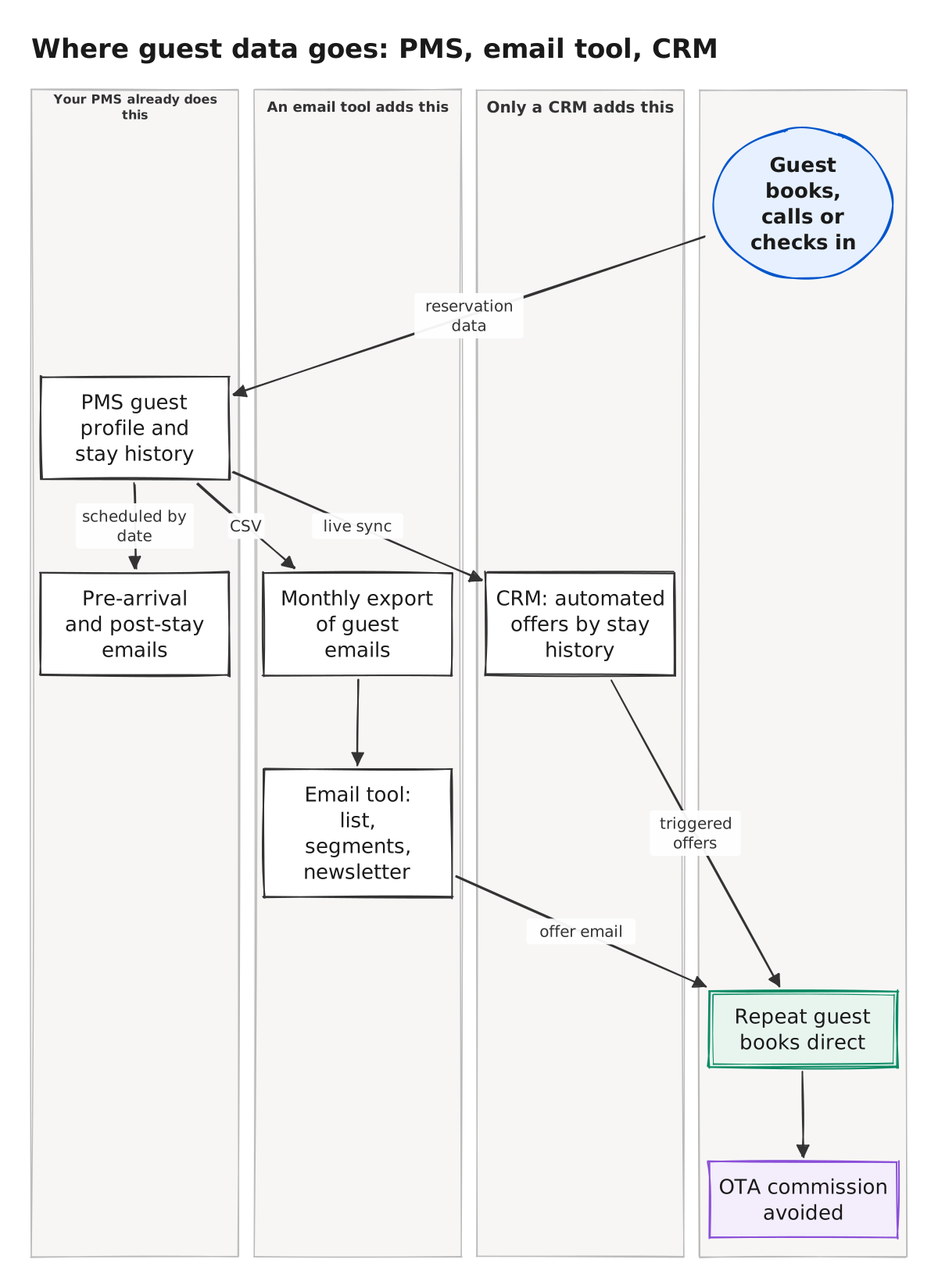
The diagram shows where each piece of guest data lives at a small property, and which tool owns each box. Your PMS already does the first lane. An email tool adds the second. Only a CRM adds the third, and the third lane is the only one with a price tag above $20 a month.
Your PMS already keeps the profile and sends the stay emails
The PMS guest profile and stay history are the first half of a CRM, and you already pay for them. Cloudbeds’ product page describes a unified guest profile that merges duplicates and consolidates “lifetime value, reservation history, and stay details” [1]. Its developer documentation splits guest communication into pre-arrival, in-house and post-departure messages and documents how the PMS itself sends emails from the front-desk app [2].
So pre-arrival and post-stay emails, the two automated messages every CRM demo opens with, are usually a template and a schedule inside the PMS you have. The confirmation, the directions email two days before arrival, the thank-you with a review link the morning after checkout: look for them in your PMS settings before you buy software to do them again. We covered the same point for the phone in how an AI receptionist fits your existing hotel tools.
What the PMS does badly is the third message: the one that goes to last winter’s guests in October saying the winter rate is open. That message needs a list of past guests, a segment, and a send that is not tied to a reservation date. This is where owners start shopping for a CRM, and where a plain email tool usually does the job.
Four things to open in your PMS this week, before you look at any vendor:
- One past guest’s profile. Count the fields that are filled: email, phone, stay dates, rate paid, notes.
- The email templates. Check whether any can be scheduled from the arrival or departure date, the way Cloudbeds documents it [2].
- The guest export. Download the list as a CSV and count the rows that have an email address.
- Last month’s OTA statement. Count the names you recognise from earlier stays.
A $20 email tool covers the newsletter and the segments
Mailchimp’s Standard plan starts at $20 a month and Essentials at $13, on its pricing page checked Oct 30, 2026 [3]. The free plan stops at 250 contacts and 500 sends a month, which a 30-room property outgrows in its first season. Prices step up as your list crosses each contact tier; the page’s selector runs 0-500, 501-1,500, 1,501-2,500, 2,501-5,000 and on up [3].
How big will the list get? In our model of a 30-room motel at 60% occupancy, the property sells about 6,570 room-nights a year. At 1.8 nights per stay that is about 3,650 stays, and if 60% of guests leave a usable email address, about 2,190 new contacts a year. After two years you sit in Mailchimp’s 2,501-5,000 contact tier [3], still far below the list sizes a hotel CRM is built around.
Mailchimp also handles the two legal chores covered below: the unsubscribe link and the postal address in the footer. What it will not do on its own is pull new guests out of the PMS. At a small property that is a monthly export of guest emails, uploaded as a CSV, or a connector app if your PMS exposes guest data to one, as Cloudbeds does [2].
HubSpot’s Marketing Hub Starter sits in the same price band at $20 a month per seat, with a limited-time $10 new-customer price shown on the day we checked [4]. Its free tier lists “Automate email campaigns” and “Create lead capture forms”; Starter adds “Remove HubSpot branding” [4]. For one owner sending a newsletter and two seasonal offers a year, either tool is more than enough.
The one case where a CRM pays: repeat guests you keep losing to OTAs
A CRM earns its fee when it moves repeat guests from an OTA to a direct booking, because each move saves a commission. Booking.com describes its commission as “a set percentage of the total booking amount” charged on each reservation, and says the exact percentage “depends on your country, property type, and the accommodation agreement you signed” [5]. Your own rate is in your Extranet under Finance [5].
The arithmetic is short. Take the yearly software cost and divide it by the commission saved per stay. At a $95 nightly rate and a 15% commission, one stay moved direct saves $14.25. HubSpot’s Marketing Hub Professional, which includes three seats and 2,000 marketing contacts, starts at $890 a month [4]. At our example prices it needs 749 moved stays a year to pay for itself.
Mailchimp Standard at $20 a month needs about 17 moved stays a year to break even, and Essentials about 11. The chart puts the four options side by side. The gap is the whole argument of this post.
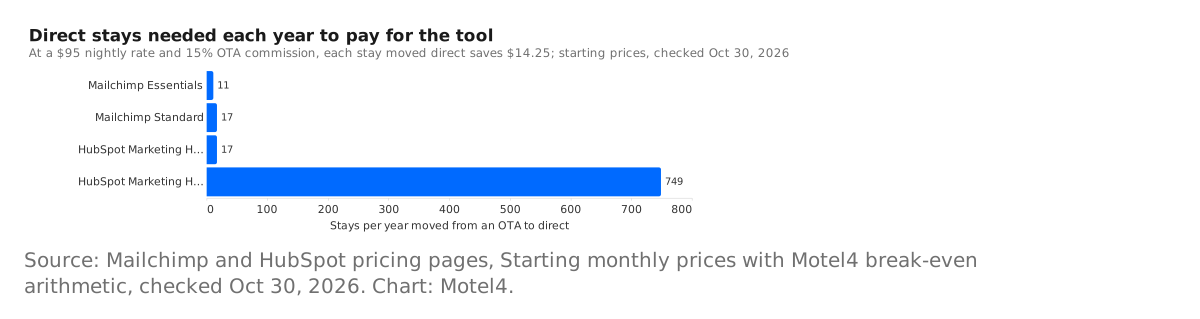
So the one case where a CRM pays is a property with a real repeat base that still books through OTAs. In our 30-room model, 749 moved stays is about a fifth of all stays in the year. If you cannot name that many returning guests, the $890 tier is a fee with nothing to recover it.
Owners of several properties, and resorts where the same families return every summer, can clear that bar. Even then, the phone is the cheaper direct channel, as we argued in the phone is your best direct-booking channel.
This assumes the moved stays would have come through an OTA at full commission, which overstates the saving when some repeat guests would have called anyway. It also leaves out your own time, which is the largest cost of running any marketing tool.
We could not confirm public prices for hotel-specific CRMs: the vendor pages we tried either publish no price or blocked automated access, so this post prices the two general tools that show their numbers. If a hotel CRM quotes you, divide its yearly fee by your own commission per stay and compare the result with the chart.
The email rules apply whichever tool sends
Federal law treats a “come back this winter” email differently from a booking confirmation, and that difference decides which tool may send it. Under 16 CFR 316.3, a message that “consists exclusively of transactional or relationship content” is transactional, while one that “consists exclusively of the commercial advertisement or promotion of a commercial product or service” is commercial [6].
A commercial email must carry “clear and conspicuous identification that the message is an advertisement or solicitation”, a notice of how to opt out, and “a valid physical postal address of the sender”, and you must stop sending within 10 business days of an opt-out request, under 15 U.S.C. 7704 [7]. Email tools add the footer and process the unsubscribes for you. A PMS template built for confirmations usually does neither, so sending offers from it puts the compliance work on you.
The confirmation, the directions email and the checkout receipt stay transactional as long as they stay about the stay. The moment you add a rate offer to the bottom of a confirmation, the primary-purpose test in 16 CFR 316.3 comes into play [6]. Check the rule with your own counsel if your list includes guests outside the US.
Verdict
Keep the PMS plus a $20 email tool if your list is under a few thousand guests and your marketing is a newsletter and a couple of seasonal offers a year. That covers the profile, the stay emails and the segments for less than one OTA commission a month.
Choose a CRM if you can count several hundred repeat guests a year who still book through OTAs, because at $14.25 saved per moved stay the $890 tier breaks even at 749 stays and pays off above that. Multi-property owners and resorts with returning families get there; a single 30-room motel usually does not.
Motel4 publishes this blog and sells an AI phone receptionist, not a CRM, so we have no CRM to sell you. The guest profile that opened this post is already in your PMS. The only question is whether you need a second system to act on it, and for most 30-room properties the answer is a $20 email tool and a monthly export.
How we did this
Search demand from Google Keyword Planner (US, pulled Oct 30, 2026). Prices from Mailchimp's and HubSpot's own pages, checked Oct 30, 2026; PMS features from Cloudbeds' product page and developer documentation; email rules from 15 U.S.C. 7704 and 16 CFR Part 316. The 30-room property model and the 15% commission are stated assumptions, not measurements. Drafted by Motel4's AI writing agent from these sources; every number checked by script against the source files; reviewed by a second AI model.
Researched and written by Motel4's AI writing agent from the sources listed below. Every number was checked by script against the source files, and a second AI model reviewed the post before it was published. The Motel4 Team is responsible for this page.
Sources
- Cloudbeds, Property management system product page (primary source), accessed Oct 30, 2026.
- Cloudbeds, Guest Communication / Reputation management (developer documentation) (primary source), accessed Oct 30, 2026.
- Mailchimp, Marketing plans and pricing (primary source), accessed Oct 30, 2026.
- HubSpot, Marketing Hub product and pricing page (primary source), accessed Oct 30, 2026.
- Booking.com, Understanding your commission (Partner Help) (primary source), accessed Oct 30, 2026.
- eCFR, Office of the Federal Register, 16 CFR Part 316, CAN-SPAM Rule (primary source), accessed Oct 30, 2026.
- Cornell Law School, Legal Information Institute, 15 U.S.C. 7704, Other protections for users of commercial electronic mail (primary source), accessed Oct 30, 2026.

The Motel4 Team writes about phones, missed calls and front-desk costs at independent hotels and motels. Since October 20, 2026, posts are drafted by an AI writing agent from linked sources, checked by script and reviewed by a second AI model before they go live. How we write. To reach us or report an error: motel4.ai/contact.