A 40-room motel needs about 150 Mbps at peak, and a 300 Mbps line covers it from $60 a month
YouTube’s help page recommends a sustained 5 Mbps for one 1080p video [1]. Netflix asks for the same 5 Mbps for Full HD [2]. Hotel wifi solutions are sold in speeds and access points, but the size of the line from the street comes down to that number times the rooms streaming at once.
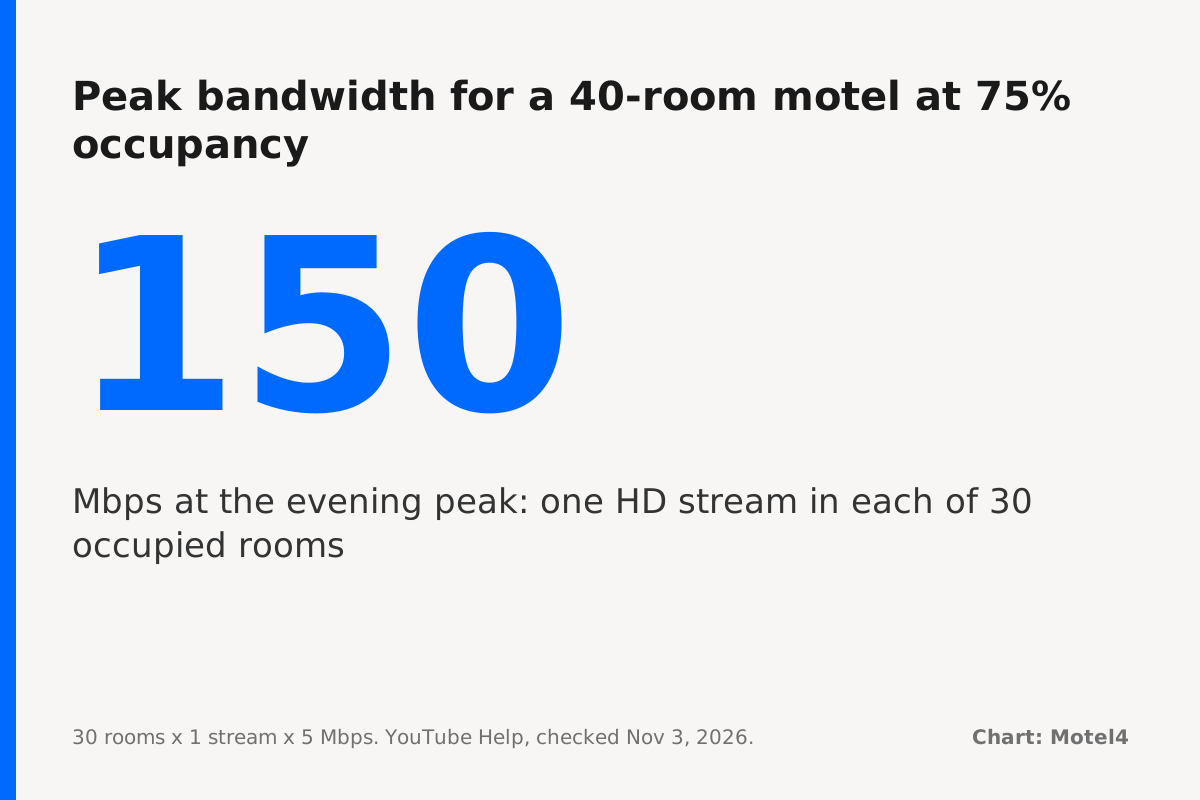
For a 40-room motel at 75% occupancy, that is about 150 Mbps at the evening peak. AT&T’s smallest Business Fiber plan, 300 Mbps, lists at $60 a month online [3], which covers that peak twice over and still covers a full house.
The math below sizes the internet line only. It leaves out the access points, cabling and router inside the building, which decide whether the far rooms see that speed, and we did not price them. Wi-Fi is also one of the routine questions guests phone the desk about, which we covered in the repetitive FAQ calls a front desk handles.
A 40-room motel needs about 150 Mbps at the evening peak
Start with 40 rooms at 75% occupancy, which is 30 occupied rooms. Give each one HD stream at the busiest moment of the evening and multiply by the 5 Mbps YouTube recommends per stream [1].
The result is 150 Mbps. Read it as a ceiling for a normal night, because it assumes every occupied room is streaming at the same moment. On a real evening some rooms are asleep, out at dinner or on phone data, so the true peak sits at or below it.
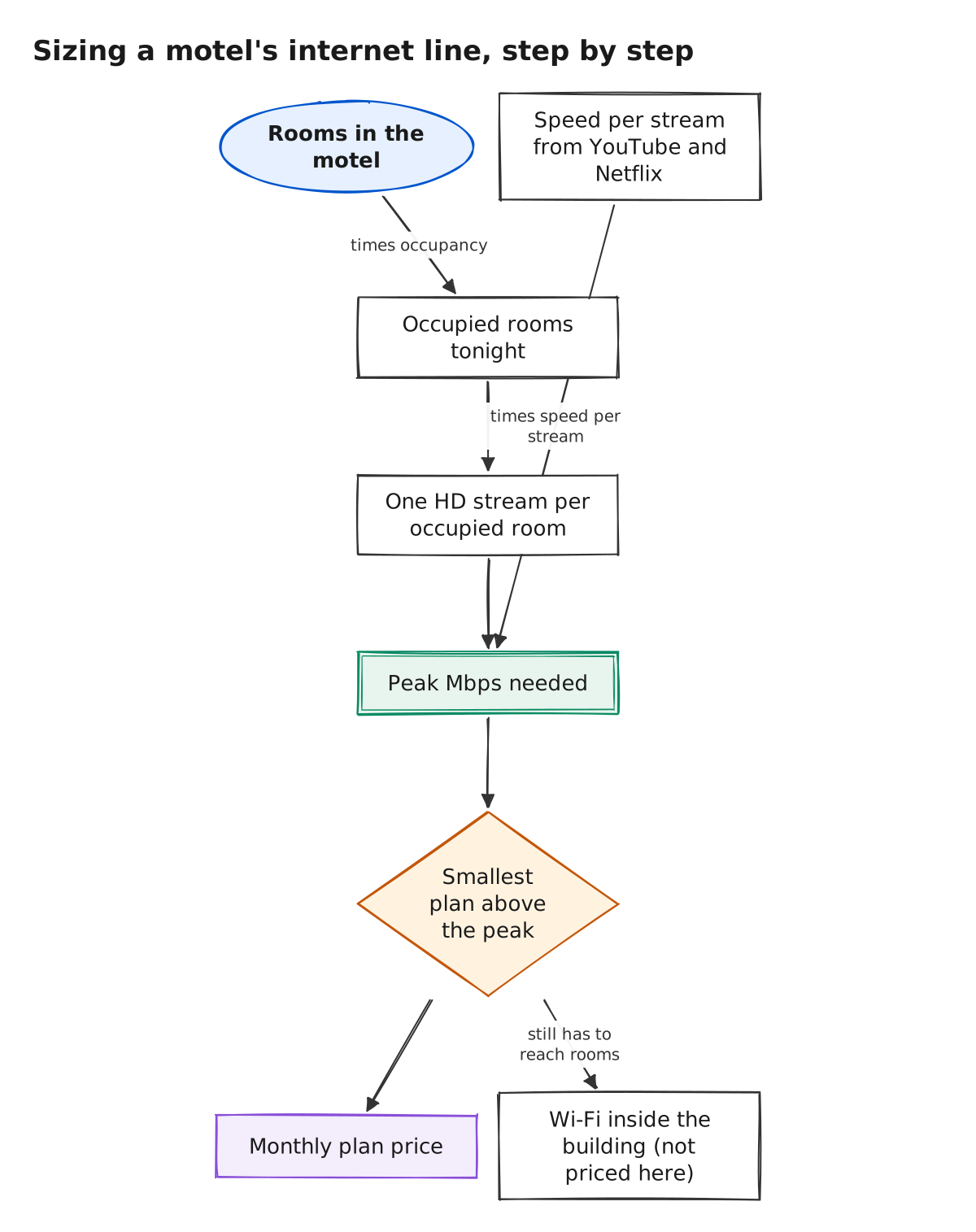
The diagram runs in the same order. Occupied rooms tonight, times one HD stream per occupied room, times the speed per stream, gives the peak Mbps needed. The smallest plan above the peak sets the monthly plan price. The Wi-Fi inside the building is a separate cost this post does not price.
Hotel wifi solutions are sized by streams, and one HD stream needs 5 Mbps
We sized the line by video because it is the one guest activity with a published speed per stream. YouTube’s system requirements list recommended sustained speeds of 2.5 Mbps for 720p, 5 Mbps for 1080p and 20 Mbps for 4K [1].
The Netflix Help Center gives 3 Mbps or higher for 720p, 5 Mbps or higher for 1080p and 15 Mbps or higher for 4K [2]. The two services agree on 5 Mbps for HD, so that is the input. They differ by 5 Mbps on 4K, and 4K is where the math changes.
Why one stream per occupied room? We found no published count of how many hotel rooms stream at the same time, so we used one per occupied room as a planning ceiling. If you sell family rooms where two people watch on separate devices, count two streams for those rooms and add 5 Mbps each.
Occupancy moves the need from 100 to 200 Mbps, and 4K multiplies it by three or four
Hold the HD rate and change occupancy, and the peak runs from 100 Mbps on a half-empty night to 200 Mbps with every room sold. Switch every stream to 4K and the same nights need 300 to 800 Mbps, depending on whose 4K figure you use [1] [2].
| Case | Occupied rooms | HD at 5 Mbps | 4K at 15 Mbps (Netflix) | 4K at 20 Mbps (YouTube) |
|---|---|---|---|---|
| Low (50% occupancy) | 20 | 100 Mbps | 300 Mbps | 400 Mbps |
| Mid (75% occupancy) | 30 | 150 Mbps | 450 Mbps | 600 Mbps |
| High (100% occupancy) | 40 | 200 Mbps | 600 Mbps | 800 Mbps |
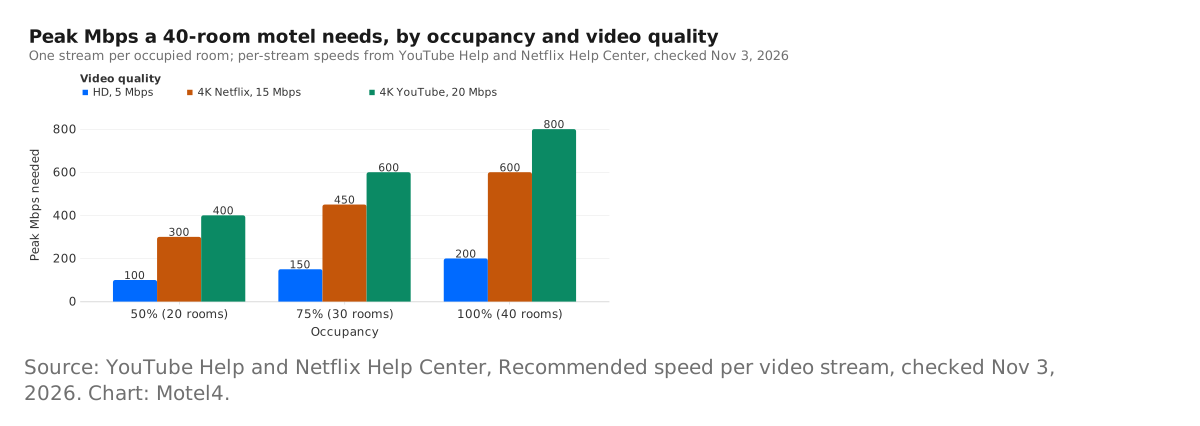
Read the table against plan sizes. A 300 Mbps line carries 60 HD streams at 5 Mbps, more streams than a 40-room motel has rooms. At YouTube’s 4K rate the same line carries 15 streams [1], so a full house of 4K viewers needs a gigabit line, which carries 50.
This assumes the building’s own Wi-Fi can deliver the speed to every room, that no room runs more than one video at a time, and that phones, laptops and software updates fit in the gap between the peak and the plan. A full house at 200 Mbps on a 300 Mbps line leaves 100 Mbps of that gap.
Prices, checked Nov 3, 2026
These are the monthly prices each provider published on its own business page on Nov 3, 2026. All are online or starting prices before taxes and fees, and none applies unless the provider serves your address.
| Provider | Plan | Speed | Monthly price | Per room, 40 rooms | Source |
|---|---|---|---|---|---|
| AT&T | Business Fiber 300 | 300 Mbps | $60 | $1.50 | [3] |
| AT&T | Business Fiber 500 | 500 Mbps | $100 | $2.50 | [3] |
| AT&T | Business Fiber 1 GIG | 1 Gbps | $140 | $3.50 | [3] |
| Verizon | Fios Business Internet 300M/300M | 300 Mbps | from $69 | $1.73 | [4] |
| Google Fiber | Business 1 Gig | 1 Gbps | from $100 | $2.50 | [5] |
AT&T shows $70, $110 and $160 struck through beside its three prices, marks them online only, and lists lower prices when the line is bundled with an eligible AT&T Business wireless plan [3]. Verizon’s $69 is a starting price for its 300 Mbps plan [4]. Google Fiber’s $100 is a starting price where it offers service [5].
The gap between enough and plenty is small. Moving from AT&T’s 300 Mbps plan to its gigabit plan adds $80 a month [3], or $960 a year. At 75% occupancy a 40-room motel sells 900 room-nights in a 30-day month, so the upgrade costs about 9 cents per occupied room-night.
Where Google Fiber serves the property, its gigabit plan starting at $100 [5] costs the same each month as AT&T’s 500 Mbps plan [3]. That makes the gigabit line the default pick in those areas, since it carries every case in the table above.
Verdict
Pick a 300 Mbps plan if your guests mostly stream in HD: at $60 to $69 a month [3] [4] it covers a full 40-room house at 5 Mbps per stream with 100 Mbps to spare. Choose a gigabit plan if your rooms have 4K TVs or guests complain about evening speed, because 4K at full occupancy needs 600 to 800 Mbps.
Either way, the line from the street is the cheap part of the bill. Start with the 5 Mbps per stream that opened this post [1]: count your rooms, multiply by your busiest occupancy, and compare the answer with the speed printed on your current internet bill.
How we did this
Search demand from Google Keyword Planner (US, pulled Nov 3, 2026). Per-stream speeds from the YouTube Help and Netflix Help Center pages, checked Nov 3, 2026. Plan prices from the AT&T, Verizon and Google Fiber business pages, checked Nov 3, 2026. Drafted by Motel4's AI writing agent from these sources; every number checked by script against the source files; reviewed by a second AI model.
Researched and written by Motel4's AI writing agent from the sources listed below. Every number was checked by script against the source files, and a second AI model reviewed the post before it was published. The Motel4 Team is responsible for this page.
Sources
- YouTube Help (Google), System requirements and supported devices for YouTube (recommended sustained speed) (primary source), accessed Nov 3, 2026.
- Netflix Help Center, Netflix-recommended internet speeds (primary source), accessed Nov 3, 2026.
- AT&T Business, AT&T Business Fiber internet plans (primary source), accessed Nov 3, 2026.
- Verizon Business, Fios Business Internet (primary source), accessed Nov 3, 2026.
- Google Fiber, Google Fiber business internet plans (primary source), accessed Nov 3, 2026.

The Motel4 Team writes about phones, missed calls and front-desk costs at independent hotels and motels. Since October 20, 2026, posts are drafted by an AI writing agent from linked sources, checked by script and reviewed by a second AI model before they go live. How we write. To reach us or report an error: motel4.ai/contact.