Negative hotel review replies: six complaints, one three-part pattern, and the rules each platform enforces

When you reply to a review on Google, the person who wrote it gets a notification, and Google’s help page says customers “can still change their review after reading your reply” [1]. The reply also stays under the review for every future guest who scrolls past it. That second reader is the one you are writing for.
The effect can be measured. Davide Proserpio and Georgios Zervas studied 5,356 Texas hotels on TripAdvisor from 2001 to 2013 and found that hotels that started replying gained 0.12 stars on average and 12% more reviews, while their negative reviews became fewer but longer [2]. For a motel with a few hundred reviews, that is the gap between two rounded scores.
Most negative hotel review response examples online hand you ten templates and stop. Below are six complaints behind most low-star hotel reviews, a reply for each, the reply rules Google, Booking.com and Expedia publish, and the federal rule some replies break. If the complaint comes by phone first, our complaint-call de-escalation scripts cover that call.
Every good reply does three things: thank, fix, invite
Google’s advice to owners is short. “Keep it short and simple: Customers value direct and honest responses,” and “Never share a reviewer’s private information” [3].
Booking.com tells partners to keep responses “short and to the point, and make sure what you write is true and accurate” [4]. Expedia Group’s partner guide says to respond within 24 hours and not to give “a copy and paste or standardized answer” [5].
Put together, a reply has three parts. Thank: name the problem back in the guest’s own words, so the next reader sees you read the review. Fix: say what changed, or what you checked and why nothing changed. Invite: one person, one channel, so the conversation leaves the public page.
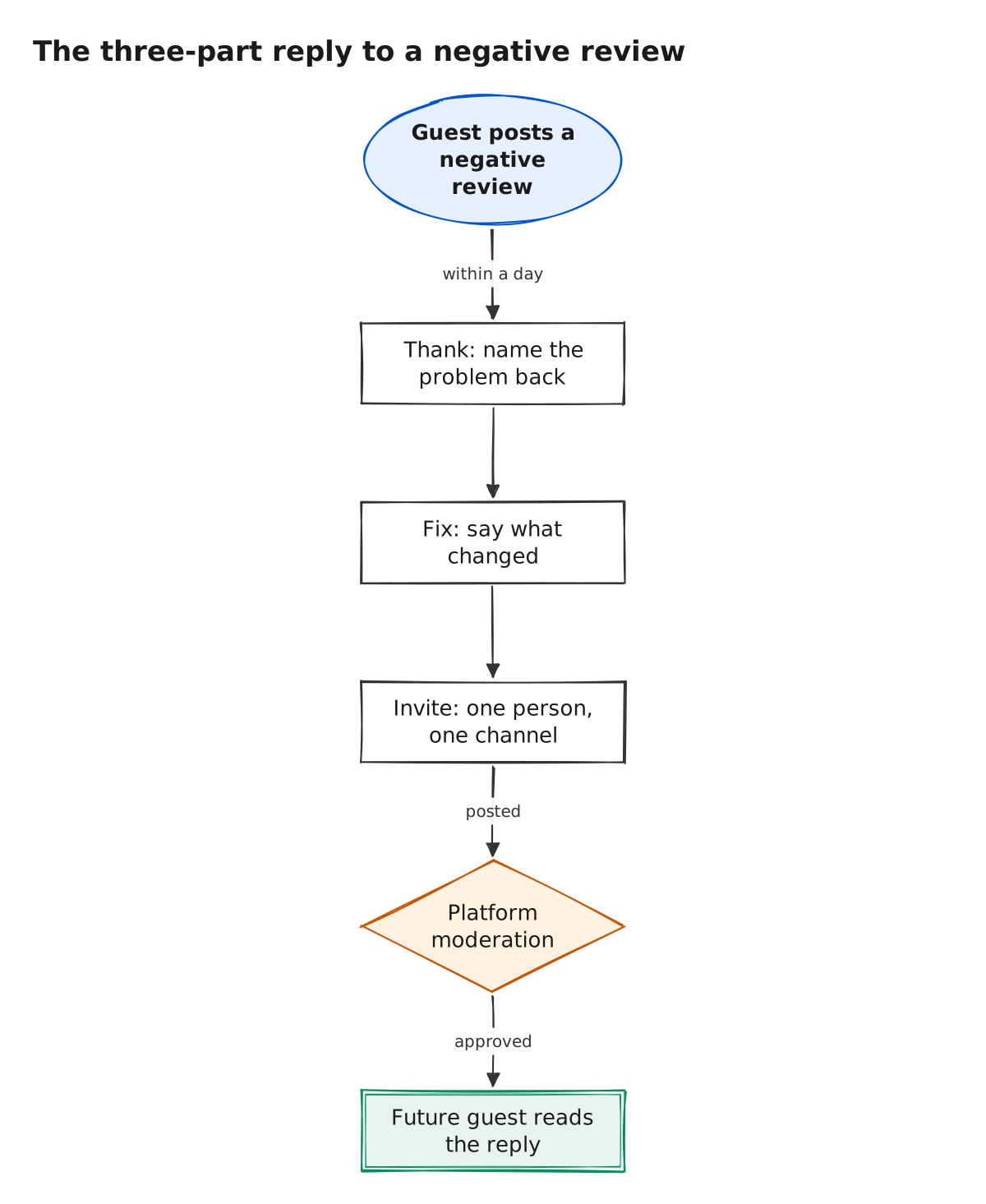
A reply never argues the rating, explains how busy the desk was, or tells the reader the guest was wrong. Platform moderation sits between you and the page, so a reply that attacks the guest may be held or never posted at all [1].
Six complaints and the reply that fixes each
The model replies below were written for this post for a small independent motel. They are templates, not quotes from any property. Keep the guest’s first name if the platform shows it, sign with your own, and keep each one to a short paragraph.
Noise
Noise reviews name a source: the highway, the ice machine, the room next door. The next reader wants to know whether the source is still there. A reply that works:
Thank you for telling us about the ice machine outside your room on Saturday night. We have moved it to the end of the breezeway, and the rooms beside the old spot now go out last. If you come back, ask for me at the desk; I am the owner and I will put you on the quiet side.
Cleanliness
A cleanliness review is the one future guests read twice. Do not call it a one-off. Say what you checked and what changed, because the reader is deciding whether the room they would get is clean today. A reply that works:
You are right that the bathroom was not ready, and I am sorry you saw it. I pulled the room from sale the morning your review came in, re-inspected it with our housekeeper, and added a second bathroom check before any room goes back on the board. Please email me directly if you would like to talk.
Fees
Fee complaints are about surprise: a deposit, a pet fee, a charge that was not in the price the guest compared. The reply should name the fee, say where it is disclosed, and say what you changed so the next guest sees it earlier. A reply that works:
Thank you for the note about the pet fee. It is on our booking page and at check-in, but you are right that it was not in the first price you saw. We have moved it into the total shown before you enter a card. If you want to go over your folio, call the front desk and ask for the owner.
Staff
A staff complaint names a person or a shift. Never name the employee in the reply, and never share anything about the guest; Google’s rules on private information apply to your reply as much as to the review [3]. Say the conversation happened and what the standard is. A reply that works:
I am sorry the check-in you got was curt. I have spoken with the evening team about how we greet guests who arrive late and tired, and we have gone back over what a welcome at our desk should sound like. I would like to hear more about that evening; please ask for the owner when you call.
Wi-Fi
Wi-Fi reviews are about work or a child’s video not loading in one room. The reader wants to know whether the building is fixed, and an apology on its own does not answer that. A reply that works:
Thank you for telling us the Wi-Fi dropped in your room. The access point that covers the far end was replaced the week after your stay, and we now test the signal in every room during the monthly maintenance walk. If it fails again for you, call the desk and we will move you.
Check-in
Check-in complaints at small properties are usually about nobody answering: a locked office, a phone that rang out, a lockbox code that never arrived. The fix the reader wants is a phone that is answered after hours and instructions that arrive before the guest does.
How you handle after-hours check-in calls decides whether the reply below is true. A reply that works:
You should not have stood outside the office at midnight, and I am sorry you did. The after-hours number is now printed on the office door and in the confirmation text, and that line is answered through the night. Thank you for writing; please ask for me, the owner, if you would like to talk.
What each platform lets you do with a reply
The rules differ in ways that change how you write, and none of the three platforms below publishes a word limit on its help page.
| Platform | Where you reply | Before it shows | Edit or delete | Rules to know | Source |
|---|---|---|---|---|---|
| Google Business Profile | Business Profile, Read reviews | Moderation, usually up to 10 minutes, sometimes up to 30 days | Edit or delete from Read reviews | Reviewer is notified and can change the review; your personal name is not shown; verified owners only | [1] |
| Booking.com | Extranet or Pulse app | Checked by Booking.com, up to 72 hours | Extranet only | Review’s language or English; only reviews with a title or comments; the score has weighted recent reviews most since January 2025 | [4] |
| Expedia Group | Post-stay reviews tool in Partner Central | Not stated on the guide page | Not stated | Guide asks for a reply within 24 hours and no copy-and-paste answers | [5] |
Flagging is separate from replying. Google removes reviews that break its content policy, such as off-topic posts, conflicts of interest and fake engagement, and a review you disagree with is not a violation [6]. Offering a refund or a discount to get a negative review removed is itself a violation of Google’s rules [3].
We could not confirm Tripadvisor’s current management-response rules. Its owner help center disallows every crawler in its robots.txt, and its guidelines page answered HTTP 403 to our fetches, so check the rules inside your Tripadvisor owner account before you post.
Tripadvisor is where hotels reply most. In the Texas data, by 2013, 31.5% of TripAdvisor reviews carried a response against 2.3% on Expedia, and the average gap between a review and its reply had fallen to 25 days [2].
The replies that break the law
The Federal Trade Commission’s rule on consumer reviews, 16 CFR Part 465, has been in force since October 21, 2024 [7]. Section 465.7 bans using “an unfounded or groundless legal threat, a physical threat, intimidation, or a public false accusation” to stop a review or get one removed [7].
Section 465.4 bans compensation or incentives for reviews “expressing a particular sentiment, whether positive or negative” [7]. Section 465.5 bars an owner or manager from writing a review of their own business without a clear disclosure, and from asking relatives or staff to post one without telling them to disclose the relationship [7].
A reply that tells a guest to expect a call from your attorney, over an honest review, is the kind of groundless legal threat the rule describes. The commission approved the rule 5-0 and said it lets the agency seek civil penalties [8]. The maximum under section 5(m)(1)(A) of the FTC Act is $53,088 per violation for penalties assessed after January 17, 2025 [9].
The older Consumer Review Fairness Act covers your paperwork. The FTC’s guidance says a registration card or booking terms may not include a clause that “bars or restricts” a guest from reviewing you, or that “imposes a penalty or fee against someone who gives a review” [10].
You may still ask a platform to remove a review that is unrelated to your property or clearly false, but a review you disagree with does not meet that bar [10].
How many good reviews move a rounded score
The authors of the Texas study point out that TripAdvisor and other sites round the displayed average to the nearest half star, so a hotel at 4.24 that crosses 4.25 jumps by half a star, and 27% of responding hotels in their data crossed such a line within six months of their first reply [2].
The box below shows what that takes for a motel at 4.2 stars with 180 reviews: 12 five-star reviews in a row with no new low ratings, using a plain average. Change the inputs to your own listing.
The box treats the score as a plain average, which is how the study describes the 2001-2013 data. Booking.com now weights its score by recency, so the newest reviews count most [4]. Either way, a small property moves its score with a handful of reviews, which is why the reply to a bad one matters more at a motel than at a big hotel.
Verdict
Pick the three-part reply for every review of three stars or fewer if you can post it within a day: thank, fix, invite, one short paragraph, no staff names, nothing about the guest. Choose a reply that states the fix alone if you have already changed what the complaint is about. Skip the reply only when the review breaks a platform rule, and flag it instead.
The reviewer may read your reply and change the review; Google says they can [1]. The rest of your readers will never tell you they read it. They will book, or they will not.
How we did this
Search demand from Google Keyword Planner (US, pulled Nov 2, 2026). Reply rules from the Google Business Profile, Booking.com Partner Help and Expedia Group partner pages, checked Nov 2, 2026. The federal rule from the Federal Register notice of Aug 22, 2024 and 16 CFR 1.98 (2026 edition). The rating effect from Proserpio and Zervas's study of Texas hotels on TripAdvisor and Expedia, 2001-2013. Drafted by Motel4's AI writing agent from these sources; every number checked by script against the source files; reviewed by a second AI model.
Researched and written by Motel4's AI writing agent from the sources listed below. Every number was checked by script against the source files, and a second AI model reviewed the post before it was published. The Motel4 Team is responsible for this page.
Sources
- Google, Read and reply to reviews (Google Business Profile Help) (primary source), accessed Nov 2, 2026.
- Davide Proserpio and Georgios Zervas, Online reputation management: estimating the impact of management responses on consumer reviews (working paper, Nov 7, 2016; Marketing Science, 2017) (primary source), accessed Nov 2, 2026.
- Google, Tips to get more reviews, including how to reply (Google Business Profile Help) (primary source), accessed Nov 2, 2026.
- Booking.com, Responding to guest reviews (Partner Help) (primary source), accessed Nov 2, 2026.
- Expedia Group, Mastering hotel guest reviews: a guide to boost your reputation (partner resources) (primary source), accessed Nov 2, 2026.
- Google, Prohibited and restricted content (Maps user contributed content policy) (primary source), accessed Nov 2, 2026.
- Federal Register via GovInfo, Trade Regulation Rule on the Use of Consumer Reviews and Testimonials, 16 CFR Part 465, final rule (89 FR 68034) (primary source), accessed Nov 2, 2026.
- Federal Trade Commission, Federal Trade Commission announces final rule banning fake reviews and testimonials (press release, Aug 14, 2024) (primary source), accessed Nov 2, 2026.
- GovInfo, 16 CFR 1.98, adjustment of civil monetary penalty amounts (1-1-26 edition) (primary source), accessed Nov 2, 2026.
- Federal Trade Commission, Consumer Review Fairness Act: what businesses need to know (primary source), accessed Nov 2, 2026.
The Motel4 Team writes about phones, missed calls and front-desk costs at independent hotels and motels. Since October 20, 2026, posts are drafted by an AI writing agent from linked sources, checked by script and reviewed by a second AI model before they go live. How we write. To reach us or report an error: motel4.ai/contact.