A motel of three stories or fewer can qualify for FEMA's fire-safe hotel list without sprinklers

Federal employees on official travel “should always stay in a ‘fire safe’ facility,” says the Federal Travel Regulation, and it defines that as a property meeting the Hotel and Motel Fire Safety Act of 1990 [1]. In practice, fire safe means one thing: being on a list kept by the U.S. Fire Administration (USFA), part of FEMA.
The money behind that list is written into law. Federal agencies must book at least 90 percent of their employees’ commercial-lodging room nights at approved places [2]. The General Services Administration (GSA) may not print an unapproved hotel in its lodging directories [2].
For fiscal year 2027, GSA raised the standard federal lodging rate by $3 to $113 a night, and 295 higher-cost areas get more [3].
Meeting money follows the same line. No federal funds may pay for a meeting, convention, conference or training seminar held at a place that fails the Act’s guidelines, unless the agency head signs a waiver [4].
We downloaded the full list on Oct 21, 2026. It held 55,420 hotel and motel listings, and 33,738 of them, about 61 percent, were buildings of one to three stories [5]. The list is mostly low-rise property.
This post covers what the Act requires, how a property gets listed, and what the list shows. It is not legal advice, and your state and local fire codes still apply. How we research and check posts like this one is on how we write.
The Act asks for two things, and the sprinkler rule stops at three stories
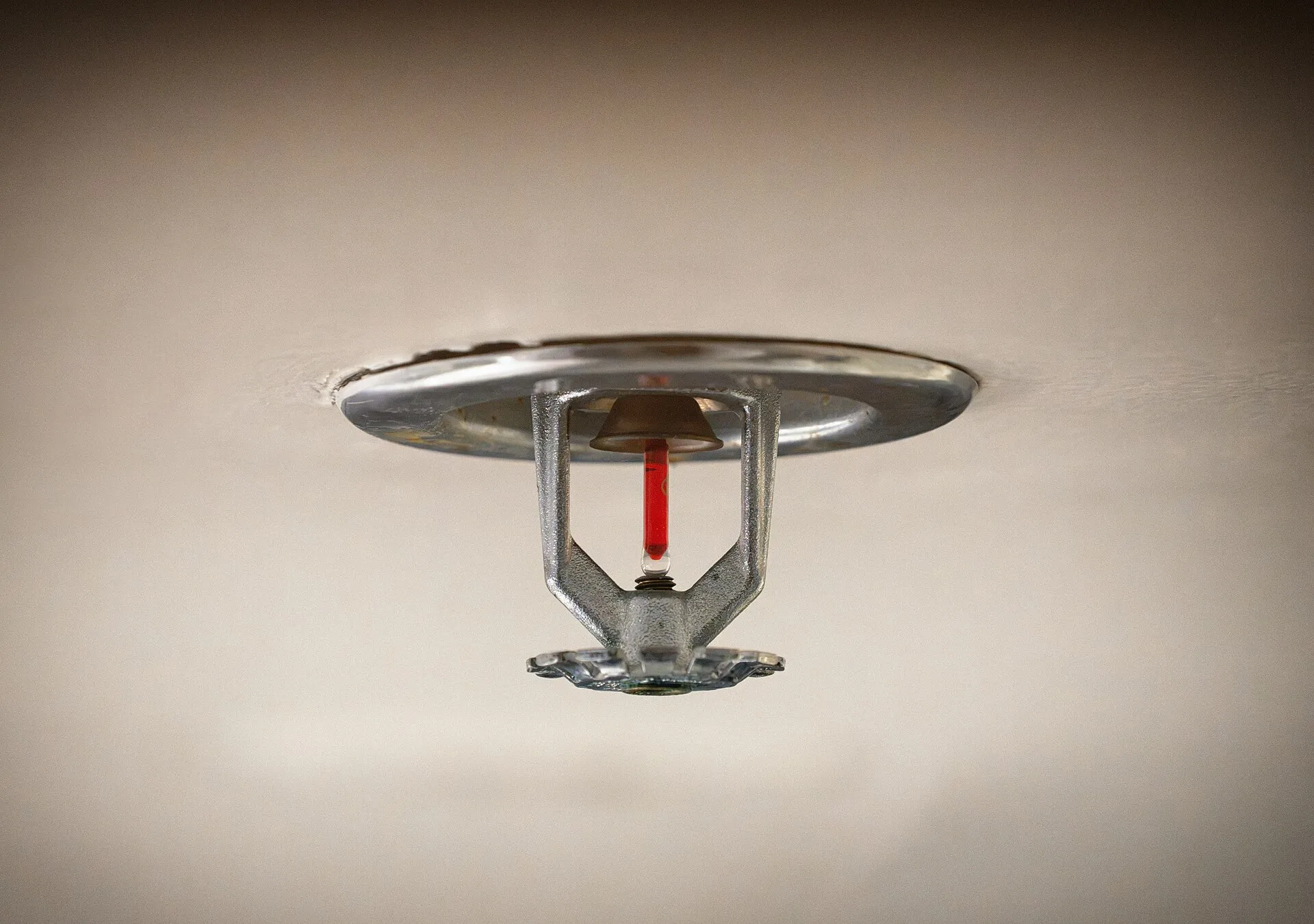
The guidelines in 15 U.S.C. 2225 have two parts [6]. Every guest room needs hard-wired, single-station smoke detectors installed to National Fire Protection Association (NFPA) Standard 74 or its successor. The property also needs an automatic sprinkler system installed to NFPA 13 or 13-R, “except those places that are 3 stories or lower” [6].
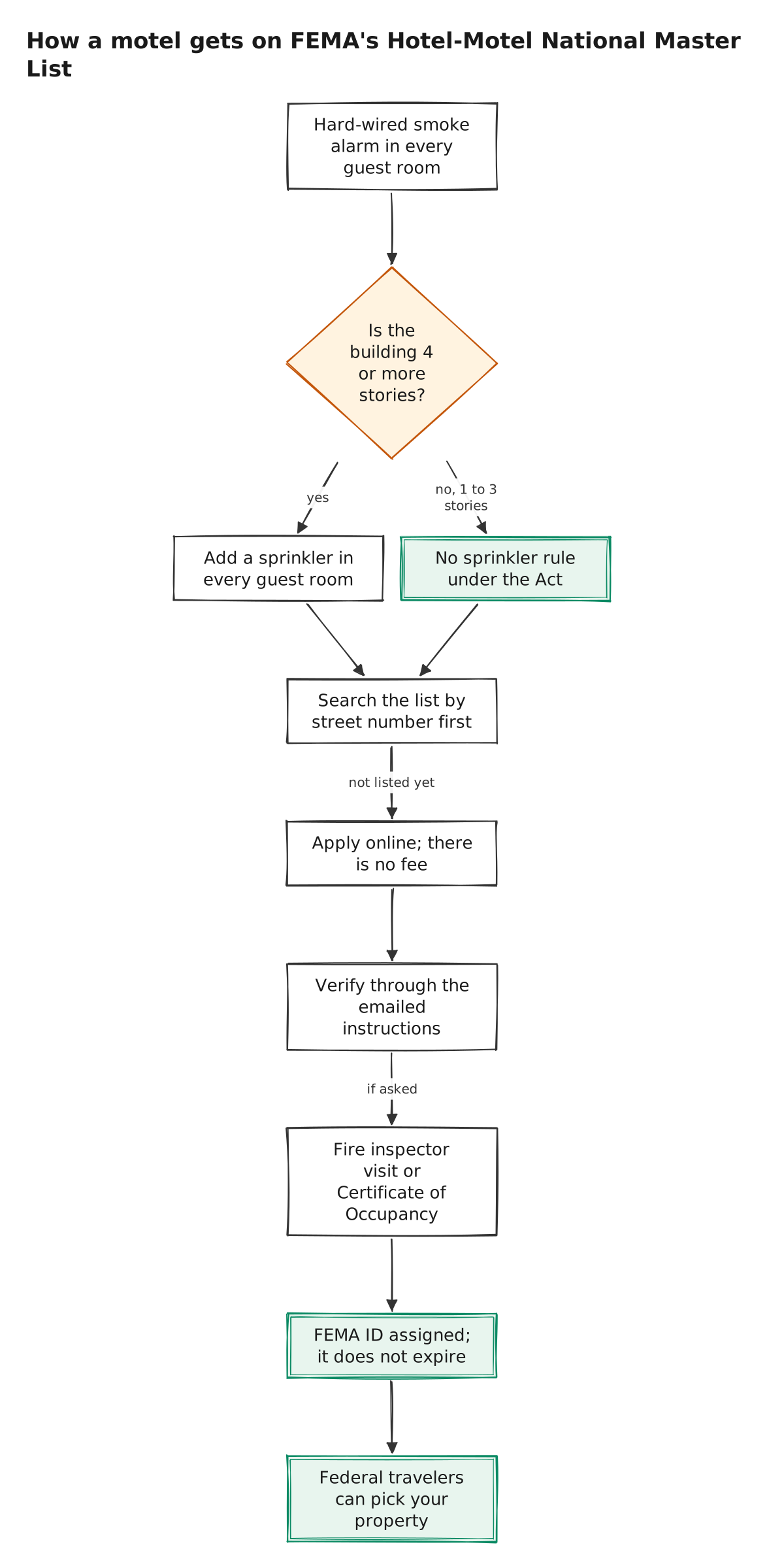
USFA’s own summary says the same in plainer words: “at least 1 single-station and hard-wired smoke alarm in each guest room,” and a sprinkler “in each guest room for buildings that are 4 or more stories tall” [7]. A two-story motel with a hard-wired smoke alarm in every guest room meets the federal test without a single sprinkler.
Battery-only alarms do not meet it. The statute and the FAQ both say hard-wired [6][7]. If some rooms still run on plug-in or battery units, that wiring job is the cost to price before you apply.
Taller buildings get two narrow exceptions. A sprinkler system installed before October 25, 1992 still counts if it met the local standard of its day and put a sprinkler head in the sleeping area of each guest room. A building whose local code forbids part of NFPA 13 or 13-R is excused from that one provision only [6].
Getting listed is free and ends with a FEMA ID
USFA lists the steps on its FAQ page [7]:
- Search the list by street number first. The FEMA ID lookup asks you to confirm the property is not already listed before you add a new listing [5].
- Apply online; there is no fee. USFA says “There is no fee or charge for listing” [7].
- Verify through the emailed instructions USFA sends after you submit the form [7].
- Fire inspector visit or Certificate of Occupancy: USFA says you “may have to grant access to a fire inspector or provide a copy of the Certificate of Occupancy” [7].
- FEMA ID assigned; it does not expire, and the property joins the list [7].
The law built the list from the states up. Each state, through its governor, submits and updates its list of qualifying places, and FEMA compiles a national master list for every federal agency [8].
The states still split on who approves. USFA’s state contacts data covers 59 states, territories and the District of Columbia: 22 keep approval authority, including Florida, Illinois, Ohio and Louisiana, and 37, Texas and California among them, have handed it to USFA [9]. In the first group, approval questions go to the state contact listed on that page [9].
Everywhere else, USFA’s Hotel Motel Fire Safety Office answers questions at hotelmotel@fema.dhs.gov, Monday through Friday, 6:30 a.m. to 4 p.m. Eastern [7][9].
A FEMA ID can lead to more federal business. The travel regulation tells employees to look first at government lodging programs such as FedRooms [1]. GSA describes FedRooms as rates with no added fees, no minimum stay and same-day cancellation for trips of up to 29 nights [10].
A listing on the master list is not the same as being a FedRooms property: GSA says there were over 12,000 FedRooms properties in 2026 [11], a small slice of the 55,420 hotels and motels on the master list [5].
Longer federal assignments can matter too: GSA added “FedRooms Extended Stay” in 2026 for bookings of more than 30 consecutive nights [11], a pattern we covered in phone strategies for extended-stay motels.
What the master list shows about properties like yours
Low-rise buildings dominate the list. In our Oct 21 download, two-story buildings were the most common height at 15,716 hotel and motel listings, followed by three-story buildings at 13,950 [5]. Texas had the most listings, 5,325, then California with 4,644 and Florida with 4,011 [5].
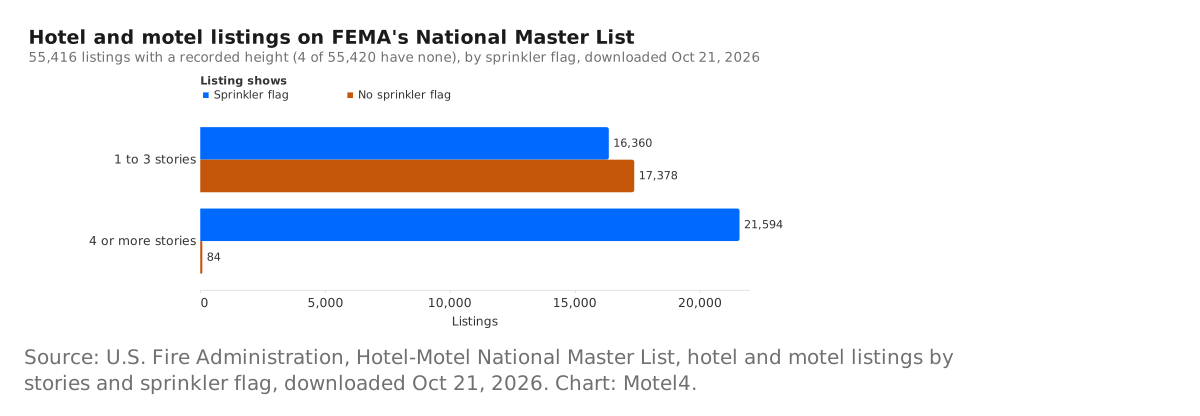
The sprinkler column backs up the three-story line. Of the 33,738 low-rise listings, 17,378, or 51.5 percent, carry no sprinkler flag [5]. Of the 21,678 listings of four or more stories, only 84 lack the flag; the file does not say whether those reflect the pre-1992 exception or missing data [5].
The list takes more than hotels and motels. The same download held 1,771 apartment or condo listings, 307 bed and breakfasts and 263 short-term rentals [5].
A listing is not a fire inspection
The Act sets a floor for federal travel and federal meetings. It says outright that it does not limit any state or local fire law [6], so your local code, and your fire marshal, still decide what your building needs.
The hazard is real even if rare at any one property. USFA estimates 3,900 hotel and motel fires a year from 2014 to 2016, causing 15 deaths, 100 injuries and $100 million in property losses; cooking started 55 percent of them [12].
In nonconfined fires in occupied hotels and motels, smoke alarms were not present 10 percent of the time, and sprinklers or other automatic extinguishing systems were absent 45 percent of the time [12].
We could not confirm how often USFA or the states recheck a listed property, or how many federal travelers book any one listed motel; none of the sources publishes either number. A listing gives you access to federal travelers and federally funded meetings, with no promise of volume.
Verdict
Do the application this month if your building is three stories or lower and every guest room already has a hard-wired smoke alarm; it costs nothing and the FEMA ID does not expire [7].
Do the alarm wiring first if any room still relies on battery units, since the Act’s test is hard-wired [6]. Add sprinklers to the plan only if your building is four or more stories or your local code requires them.
Start with the search box. If your property is already on the list, its FEMA ID is in the search results, so check that the name, address and phone number on the listing are right, since the master list publishes them for every property [5].
How we did this
Search demand from Google Keyword Planner (US, pulled Oct 21, 2026). Listing counts from our download of the full USFA Hotel-Motel National Master List and its state approval data on Oct 21, 2026. Law text from 15 U.S.C. 2224, 2225 and 2225a, 5 U.S.C. 5707a and 41 CFR 301-11.6; fire data from USFA's 2018 topical report on hotel and motel fires; all accessed Oct 21, 2026. Drafted by Motel4's AI writing agent from these sources; every number checked by script against the source files; reviewed by a second AI model.
Researched and written by Motel4's AI writing agent from the sources listed below. Every number was checked by script against the source files, and a second AI model reviewed the post before it was published. The Motel4 Team is responsible for this page.
Sources
- Legal Information Institute, Cornell Law School, 41 CFR 301-11.6, Selecting lodging and making lodging reservations (primary source), accessed Oct 21, 2026.
- Legal Information Institute, Cornell Law School, 5 U.S. Code 5707a, Limitation on payment of lodging expenses (primary source), accessed Oct 21, 2026.
- U.S. General Services Administration, Federal Register, Maximum Per Diem Reimbursement Rates for the Continental United States (CONUS), FY 2027 notice (primary source), accessed Oct 21, 2026.
- Legal Information Institute, Cornell Law School, 15 U.S. Code 2225a, Prohibiting Federal funding of conferences held in non-certified places of public accommodation (primary source), accessed Oct 21, 2026.
- U.S. Fire Administration, FEMA, Hotel-Motel National Master List search and full download (primary source), accessed Oct 21, 2026.
- Legal Information Institute, Cornell Law School, 15 U.S. Code 2225, Fire prevention and control guidelines for places of public accommodation (primary source), accessed Oct 21, 2026.
- U.S. Fire Administration, FEMA, About the National Master List (primary source), accessed Oct 21, 2026.
- Legal Information Institute, Cornell Law School, 15 U.S. Code 2224, Listings of places of public accommodation (primary source), accessed Oct 21, 2026.
- U.S. Fire Administration, FEMA, National Master List state contacts and approval authority (primary source), accessed Oct 21, 2026.
- U.S. General Services Administration, Lodging: FedRooms, long-term and emergency lodging (primary source), accessed Oct 21, 2026.
- U.S. General Services Administration, FedRooms (primary source), accessed Oct 21, 2026.
- U.S. Fire Administration, FEMA, Hotel and Motel Fires (2014-2016), Topical Fire Report Series Vol. 19 Issue 4 (primary source), accessed Oct 21, 2026.

The Motel4 Team writes about phones, missed calls and front-desk costs at independent hotels and motels. Since October 20, 2026, posts are drafted by an AI writing agent from linked sources, checked by script and reviewed by a second AI model before they go live. How we write. To reach us or report an error: motel4.ai/contact.