A 40-room motel at 70% occupancy needs 1.5 housekeeper shifts a day, and three people on the roster
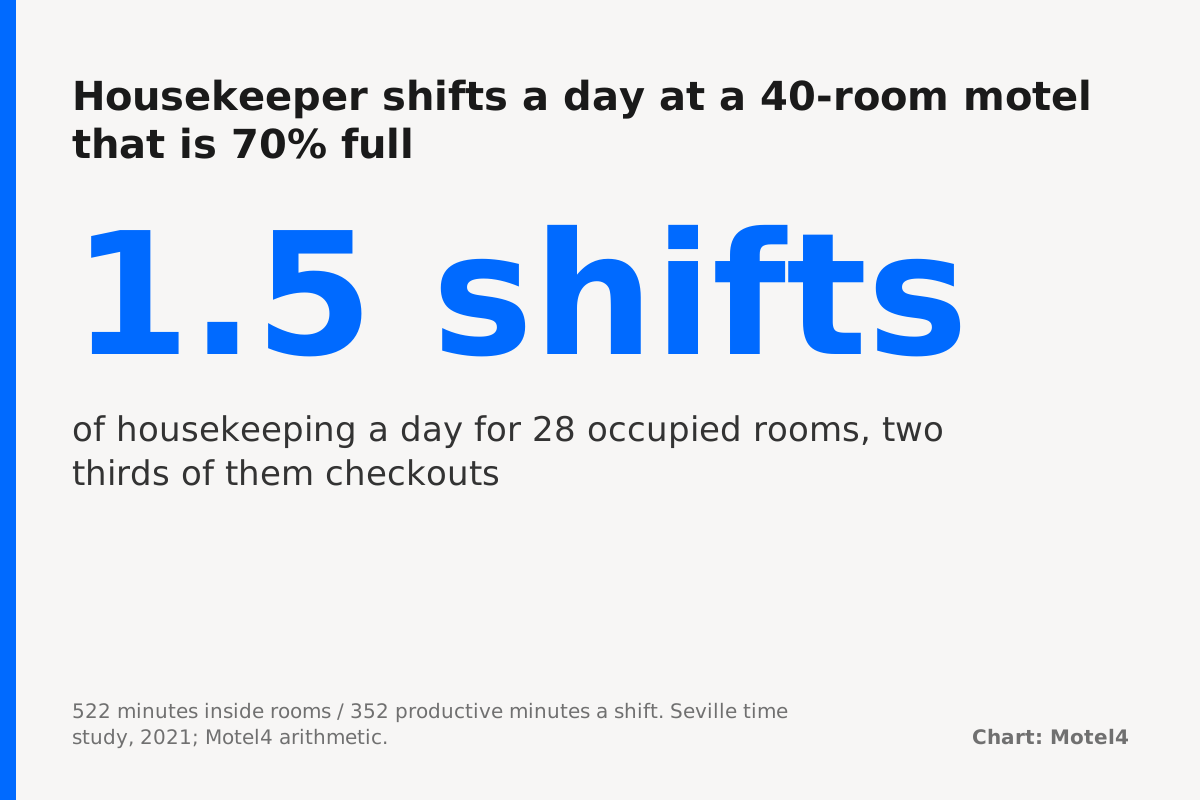
At a 74-room hotel in Seville, Spain, a housekeeper is usually assigned 19 rooms in an eight-hour day, and a 2021 stopwatch study clocked the average room at 18.52 minutes, extras included [1]. Multiply the two and you get 352 minutes. The other 128 minutes of every shift go to the cart, the linen, the floor office and breaks.
That gap is the number most hotel housekeeping staffing guides skip. Maids and housekeeping cleaners at US hotels and motels earned a median $16.79 an hour in May 2025, the Bureau of Labor Statistics reports [2]. At a 40-room motel running 70% full, that means 1.48 eight-hour shifts a day and about $6,500 a month in wages and payroll tax.
The math covers the rooms themselves: how many need a clean, how long each takes, and how much of a paid shift is spent inside them. It leaves out on-site laundry, public areas, deep cleans and the manager’s own hours. Every input sits in the box below and the evidence files, which is how we write every post.
A 40-room motel at 70% occupancy needs 1.48 housekeeper shifts a day
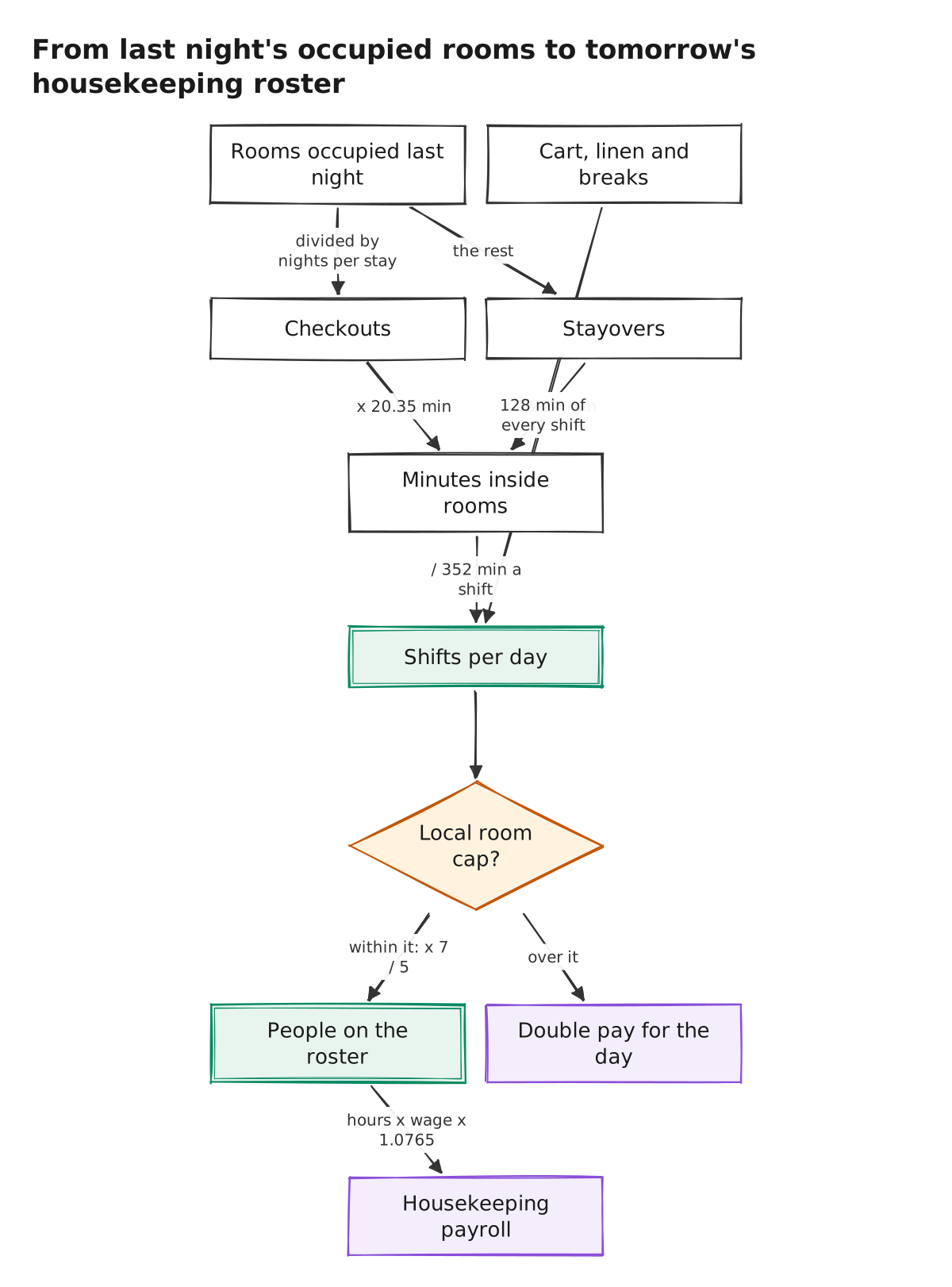
Start with last night’s count. At 70% occupancy, 28 of the 40 rooms were occupied. With an average stay of 1.5 nights, two thirds of those guests leave today, so the day holds about 19 checkouts and 9 stayovers. A checkout took 20.35 minutes in the Seville study and a stayover 15.24 [1].
That is 522 minutes inside rooms, or 1.48 shifts of 352 productive minutes. Call it 1.5: one full-time housekeeper plus one on a half day. Over a week it is 10.4 shifts, and a full-time housekeeper covers 5, so the motel needs 2.08 full-time equivalents and, once days off and sick days are counted, three people on the roster.
The wage line follows. Those 1.48 shifts are 11.9 paid hours a day. At the $16.79 median plus the employer’s 6.2% Social Security and 1.45% Medicare tax [3], an hour costs $18.07, so the day costs about $215, or $7.66 per occupied room. Over a 30.4-day month that is $6,522 before benefits, laundry or supplies.
Where the other two hours of each shift go
Housekeepers in the Seville hotel spend about 73% of a shift inside rooms, by our arithmetic from the paper’s figures: 19 rooms at 18.52 minutes is 352 of 480 minutes [1]. The rest is the cart, linen and breaks. A staffing model that divides the shift by minutes per room alone will understaff you by about a quarter.
Some of that time is required by law. In California a housekeeper on an eight-hour shift gets two paid 10-minute rest periods, one for every four hours worked or major fraction of it [4], and a 30-minute meal period once the work period passes five hours [5].
The meal period is unpaid when the worker is relieved of all duty, so an eight-hour shift keeps a person on site for eight and a half hours.
Squeezing the gap has a cost the study measured. For each extra room assigned to a housekeeper, the time spent per room fell by almost 33 seconds, which the authors read as people rushing to finish inside their paid hours [1].
In California that rush is also a compliance question. Cal/OSHA’s hotel housekeeping rule, in force since July 1, 2018, makes every hotel, motel and bed and breakfast evaluate “excessive work-rate” and “inadequate recovery time between housekeeping tasks” at least once a year, and keep the records ready for inspection within 72 hours [6].
Checkouts set the minutes, so pull your average stay from the PMS
The checkout share is one divided by the average length of stay. At 1.5 nights, 67% of today’s occupied rooms are checkouts; at 1.2 nights it is 83%, and at a 3-night average only 33%. Because a checkout took a third longer than a stayover in Seville [1], the stay length moves the shift count more than most owners expect.
| Average stay | Checkouts today | Stayovers | Shifts a day | Full-time equivalents |
|---|---|---|---|---|
| 1.2 nights | 23.3 | 4.7 | 1.55 | 2.17 |
| 1.5 nights | 18.7 | 9.3 | 1.48 | 2.08 |
| 3 nights | 9.3 | 18.7 | 1.35 | 1.89 |
Pace matters as much. The Seville times are fast, and the paper’s own review of earlier studies says so: a US all-suite hotel averaged 43 minutes for a checkout and 23 for a stayover, a survey of 941 US room cleaners found 15.3 rooms a day, and two luxury hotels assigned 12 [1].
At the all-suite pace, the same 28 rooms need 2.89 shifts a day, almost twice the Seville figure.
Time your rooms before you trust either number. Ten checkouts and ten stayovers on a phone stopwatch, spread across your housekeepers, give the two minutes-per-room inputs; your PMS gives occupancy and average stay. Housekeepers who also answer the desk phone lose minutes to every ring, and our post on phone interruptions at the front desk puts a cost on them.
How the result moves: 50%, 70% and 90% occupancy
Occupancy scales the whole model. Each row below keeps the 1.5-night stay and the Seville minutes and changes only how full the motel was last night.
| Case | Occupied rooms | Minutes inside rooms | Shifts a day | Full-time equivalents | Wages a month at the median |
|---|---|---|---|---|---|
| Low (50%) | 20 | 373 | 1.06 | 1.48 | $4,658 |
| Mid (70%) | 28 | 522 | 1.48 | 2.08 | $6,522 |
| High (90%) | 36 | 671 | 1.91 | 2.67 | $8,385 |
The jump from 50% to 90% occupancy adds less than one shift a day, because the cart, linen and breaks are paid per shift whatever the house count. A Tuesday at 50% and a Saturday at 90% want different rosters, so schedule from the week’s bookings rather than from a flat quota.
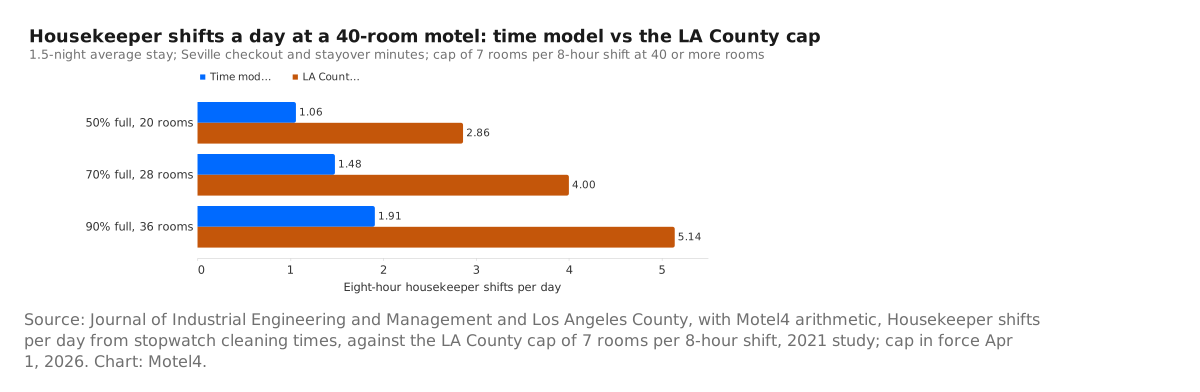
Local law can override the stopwatch. Since April 1, 2026, hotels in unincorporated Los Angeles County may not require a housekeeper to clean more than 3,500 square feet in an eight-hour day if the hotel has 40 or more rooms, or 4,500 square feet if it has fewer than 40 [7].
Once seven or more rooms are assigned, each room counts as 500 square feet whatever its size [7]. That caps a housekeeper at 7 rooms a day in a 40-room motel and 9 in a 39-room one, so the fortieth room is an expensive door.
At 28 occupied rooms the cap needs 4 housekeepers on the floor, against 1.48 shifts by the time model, and the chart shows the same gap at 50% and 90%. Over the cap, the county requires double the regular rate for every hour worked that day [7].
Only unincorporated parts of the county are covered. If your city has its own hotel worker ordinance, read its text before you set quotas.
The wage you pay moves the bill, and the roster stays the same. The table repeats the 70% case at the BLS 10th percentile, median and 90th percentile wages for housekeepers in lodging [2][8][9], each with 7.65% payroll tax added.
| Wage case | Hourly wage | Cost per hour with tax | Wages a month, 11.9 hours a day |
|---|---|---|---|
| Low (10th percentile) | $12.95 | $13.94 | $5,030 |
| Mid (median) | $16.79 | $18.07 | $6,522 |
| High (90th percentile) | $23.80 | $25.62 | $9,245 |
This assumes a motel cleans at the Seville pace and nobody is sick or on vacation. The study covers one 4-star hotel with 18-square-meter rooms and did not measure how clean they ended up [1]. Benefits and workers’ compensation come on top of the wage line, so treat the dollar figures as a floor. None of this is legal advice.
Verdict
Pick the time model if your motel is outside a capped jurisdiction: time ten rooms of each kind, divide your occupied rooms by your average stay, and budget 352 productive minutes per shift until your own stopwatch says otherwise.
Choose the room cap as your planning number if you are in unincorporated Los Angeles County, because 7 rooms per housekeeper sets the roster before the minutes do.
Keep a third person on the roster if the model gives more than 1.43 shifts a day: two full-timers cover 10 shifts a week and a 40-room motel at 70% needs 10.4. Redo the sum whenever the average stay changes, since a week of 3-night guests needs 1.35 shifts a day and a week of 1.2-night guests 1.55.
The Seville hotel’s 19 rooms a day is one hotel’s answer. The number that matters is the one on your own stopwatch, with the 128 minutes outside the rooms counted in.
How we did this
Search demand from Google Keyword Planner (US, pulled Oct 28, 2026). Cleaning minutes per room and rooms assigned per shift from the 2021 stopwatch study by Aguilar-Escobar and colleagues in the Journal of Industrial Engineering and Management, read in full Oct 28, 2026; the productive minutes per shift and every staffing figure are Motel4 arithmetic saved in the evidence files. Wages from the BLS Occupational Employment and Wage Statistics for May 2025, read through the BLS Public Data API on Oct 28, 2026; payroll tax rates from the IRS. Workload rules from Los Angeles County's Hotel Worker Protection Ordinance page, Cal/OSHA Title 8 section 3345 and California's rest and meal period FAQs, all read Oct 28, 2026. Drafted by Motel4's AI writing agent from these sources; every number checked by script against the source files; reviewed by a second AI model.
Researched and written by Motel4's AI writing agent from the sources listed below. Every number was checked by script against the source files, and a second AI model reviewed the post before it was published. The Motel4 Team is responsible for this page.
Sources
- Journal of Industrial Engineering and Management, Hotel room cleaning: time study and analysis of influential variables in a Spanish hotel (Aguilar-Escobar, Garrido-Vega, Majado-Marquez and Camunez-Ruiz, 2021, vol. 14 no. 3, pp. 645-660) (primary source), accessed Oct 28, 2026.
- U.S. Bureau of Labor Statistics, Public Data API, OEWS May 2025: hourly median wage, maids and housekeeping cleaners (37-2012) in traveler accommodation (NAICS 721100), series OEUN000000072110037201208 (primary source), accessed Oct 28, 2026.
- Internal Revenue Service, Topic no. 751, Social Security and Medicare withholding rates (primary source), accessed Oct 28, 2026.
- California Department of Industrial Relations, Division of Labor Standards Enforcement, Rest periods, frequently asked questions (primary source), accessed Oct 28, 2026.
- California Department of Industrial Relations, Division of Labor Standards Enforcement, Meal periods, frequently asked questions (primary source), accessed Oct 28, 2026.
- California Department of Industrial Relations (Cal/OSHA), California Code of Regulations, Title 8, Section 3345: Hotel Housekeeping Musculoskeletal Injury Prevention (primary source), accessed Oct 28, 2026.
- Los Angeles County Department of Consumer and Business Affairs, Hotel Worker Protection Ordinance (primary source), accessed Oct 28, 2026.
- U.S. Bureau of Labor Statistics, Public Data API, OEWS May 2025: hourly 10th percentile wage, maids and housekeeping cleaners in traveler accommodation, series OEUN000000072110037201206 (primary source), accessed Oct 28, 2026.
- U.S. Bureau of Labor Statistics, Public Data API, OEWS May 2025: hourly 90th percentile wage, maids and housekeeping cleaners in traveler accommodation, series OEUN000000072110037201210 (primary source), accessed Oct 28, 2026.

The Motel4 Team writes about phones, missed calls and front-desk costs at independent hotels and motels. Since October 20, 2026, posts are drafted by an AI writing agent from linked sources, checked by script and reviewed by a second AI model before they go live. How we write. To reach us or report an error: motel4.ai/contact.