A hotel housekeeping checklist with stopwatch times for every step, and the local caps on rooms per shift

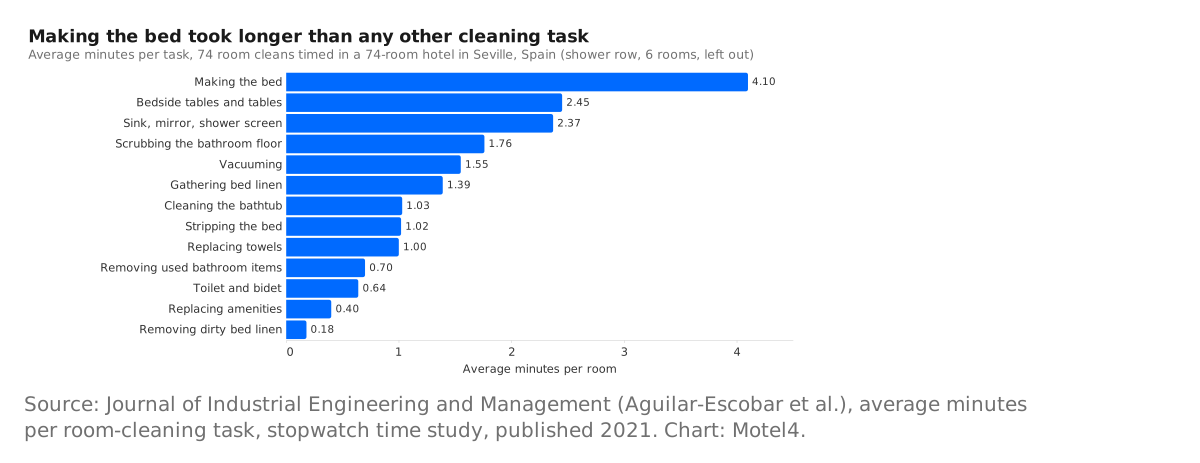
In 2021, four researchers published a stopwatch study of room cleaning at a 74-room, 4-star hotel in Seville, Spain, in the Journal of Industrial Engineering and Management [1]. They timed 74 cleans, task by task. Making the bed took longest, at 4.10 minutes on average and almost a quarter of all cleaning time.
Most housekeeping checklists stop at the list of tasks. The minutes are what let you set a fair workload and staff the right hours. Housekeeping is a big payroll line as well: traveler accommodation employed 415,160 maids and housekeeping cleaners in May 2025, at a median wage of $16.79 an hour [2].
Below is a hotel housekeeping checklist in an order that puts the disinfectant’s waiting time to use, with the study’s minutes next to each step. After it come a formula for tomorrow’s staffing hours and the California rules that now treat housekeeping workload as a safety and pay question.
The hotel housekeeping checklist, in cleaning order
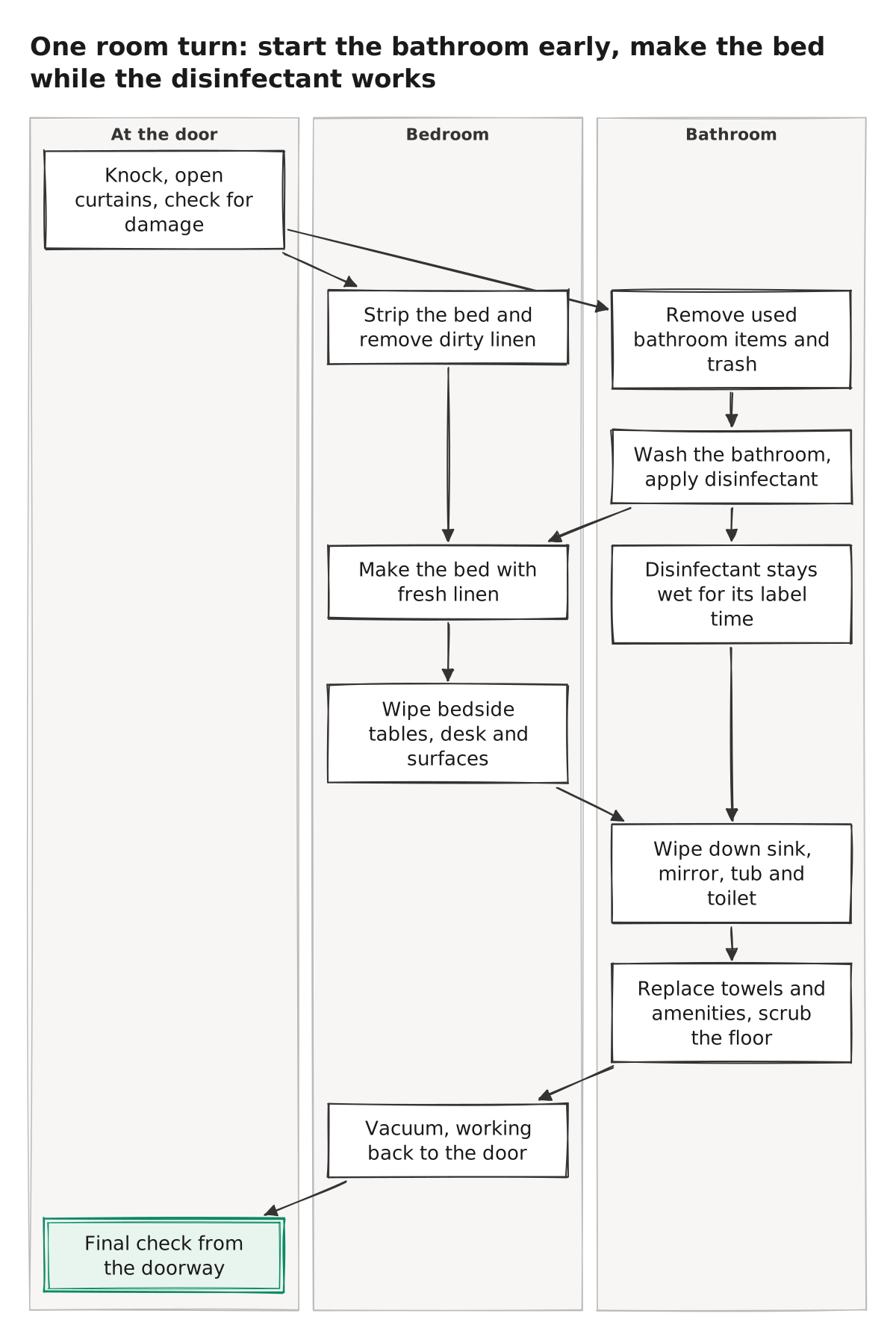
Start the bathroom early so the disinfectant works while you make the bed. CDC’s guidance says to clean with soap and water first, then keep the disinfectant wet on the surface for the whole contact time on its label [3]. The minutes below are the Seville averages [1].
- Knock, open curtains, check for damage. Look for left items and anything broken before you start. CDC also advises opening windows or running fans when you disinfect [3]. Not timed in the study.
- Strip the bed and remove dirty linen. Stripping took 1.02 minutes and taking the dirty linen out 0.18, and the study logged another 1.39 minutes for gathering bed linen [1].
- Remove used bathroom items and trash. Used and dirty bathroom items took 0.70 minutes [1].
- Wash the bathroom, apply disinfectant. Soap and water first, then the disinfectant, and never mix two products [3]. The study did not time this on its own.
- Make the bed with fresh linen. This was the longest task, at 4.10 minutes [1], and the disinfectant stays wet for its label time while you do it.
- Wipe bedside tables, desk and surfaces. Bedside tables and tables took 2.45 minutes [1].
- Wipe down sink, mirror, tub and toilet. The sink, mirror and shower screen took 2.37 minutes, the bathtub 1.03 and the toilet and bidet 0.64 [1].
- Replace towels and amenities: 1.00 and 0.40 minutes [1].
- Scrub the bathroom floor: 1.76 minutes [1].
- Vacuum, working back to the door: 1.55 minutes [1].
- Final check from the doorway. Look at the room the way the next guest will, and tell the front desk about anything broken before the room is sold. Not timed.
Five tasks took 68% of all cleaning time: the bed, the bedside tables and other surfaces, the sink area, the bathroom floor and vacuuming [1]. The authors say training should focus on those five, and that hotel designers could plan rooms around them [1].
A checkout took 20 minutes in the study, so plan for more
A checkout averaged 20.35 minutes in Seville. A stayover, where the guest stays on and the sheets are not changed, averaged 15.24 [1]. That makes the checkout about 34% longer. Bigger rooms took longer too: a checkout in an 18-square-meter standard double averaged 19.66 minutes, against 26.59 for a 37-square-meter suite [1].
These are fast times, and the authors say so: their averages came in below the earlier studies they reviewed [1]. In that review, a US all-suite hotel averaged 23 minutes for a stayover and 43 for a checkout, and a hotel in Israel took 42 to 44 minutes per checkout [1].
The Seville clock also stopped at the room door. It timed only the work inside each room, and the authors note that extras and rest time have to be added before you set a standard time [1]. At a motel, that outside time includes the cart, the laundry and the walk between buildings.
One more result matters for quotas. Each extra room assigned to a housekeeper cut the time spent per room by about 33 seconds [1]. The authors read this as people rushing to finish inside their paid hours, and flag it as a health and safety problem [1].
The person mattered less than the room: age, seniority, training and contract type had no statistically significant effect on cleaning time [1].
Turn the times into tomorrow’s housekeeping hours
Multiply each kind of clean by its time and add them up. Take a 30-room motel after a night with 20 rooms sold: 12 departures to turn and 8 stayovers to service. At the Seville averages [1]:
That is 6.1 hours of work inside rooms. At the US all-suite averages of 43 and 23 minutes [1], the same board takes 11.7 hours. At the median wage of $16.79 an hour [2], that is about $102 to $196 in wages for the day, before payroll taxes and time outside the rooms.
| Timing used | Checkout | Stayover | Hours for 12 + 8 rooms | Wages at $16.79 an hour |
|---|---|---|---|---|
| Seville study averages [1] | 20.35 min | 15.24 min | 6.1 | $102 |
| US all-suite hotel, 2016 [1] | 43 min | 23 min | 11.7 | $196 |
The gap between those two rows is the reason to time your own rooms. Time at least five checkouts and five stayovers with a phone stopwatch, spread across your housekeepers so one fast or slow person does not set the number. Then put your own averages into the same formula.
California treats housekeeping workload as a safety issue
The work is hard on bodies. A 1999-2005 study of 40,030 workers at 87 unionized US hotels found housekeepers had a 61% higher risk of injury than other hotel employees, as summarized in the Seville paper [1].
Every California hotel, motel or bed and breakfast that employs housekeepers falls under Cal/OSHA’s hotel housekeeping rule, Title 8 section 3345, in force since July 1, 2018 [4]. It requires a written musculoskeletal injury prevention program, a worksite evaluation reviewed at least once a year, and training at least yearly in a language your housekeepers understand [4].
The evaluation has to cover a list of risks that reads like the checklist above. It names torso bending, twisting, kneeling and squatting, pushing and pulling, “excessive work-rate” and “inadequate recovery time between housekeeping tasks” [4]. A timed checklist gives you numbers for the work-rate part, and Cal/OSHA can ask to see your records within 72 hours [4].
Outside California, the federal baseline for cleaning chemicals still applies. CDC’s guidance points employers to OSHA’s hazard communication standard, 29 CFR 1910.1200, and to keeping Safety Data Sheets available for every cleaning product [3].
Some local laws cap rooms per shift
Two California jurisdictions cap the workload itself. Since April 1, 2026, unincorporated Los Angeles County has limited a housekeeper to 4,500 square feet of rooms per eight-hour day in a hotel with fewer than 40 rooms, and 3,500 in a larger one [5]. Over the limit, the hotel pays double for every hour worked that day [5].
Once seven or more rooms are assigned, each counts as 500 square feet whatever its size [5]. That allows at most nine rooms a day in a hotel under 40 rooms, and seven in a larger one. The 20-room board above would need three housekeepers there, though the in-room work fits one shift at the Seville pace.
Those caps sit well below the quotas in the paper’s review: a survey of 941 US room cleaners reported 15.3 rooms a day, and two US luxury hotels assigned 12 [1]. The county’s summary page lists no minimum hotel size, so read the ordinance’s definitions before you assume a small motel is exempt [5].
Santa Monica adopted similar limits in 2019: 4,000 square feet a day for hotels with fewer than 40 rooms and 3,500 for larger ones, with double pay above them [6]. The city said Long Beach, Oakland and Seattle had similar ordinances [6]. If your city has one, read its current text before you set quotas.
To be fair, the Seville numbers come from one 4-star hotel whose standard rooms measure 18 square meters, and the study did not measure how clean the rooms ended up [1]. A motel with exterior doors and a tub in every room may run slower. This post explains rules and published data, and it is not legal advice.
Verdict
Pick a minutes-based workload if you assign housekeeping as a flat number of rooms today. Time ten rooms this week and budget each day by room type and type of clean, which is what the Seville authors recommend over fixed room counts [1].
Choose the lower room count if you operate in unincorporated Los Angeles County or Santa Monica, where the square-footage caps set the quota before the stopwatch does. In California, add the timed checklist to your written injury prevention program, since the rule already asks you to look at work rate [4].
The next thing to time is the work outside the rooms. If the person cleaning also covers the desk phone, count those interruptions too; our post on phone interruptions at the front desk looks at that side.
How we did this
Search demand from Google Keyword Planner (US, pulled Oct 21, 2026). Task and room times from the 2021 stopwatch study by Aguilar-Escobar and colleagues in the Journal of Industrial Engineering and Management, including its table of earlier studies. Wages from the BLS OEWS May 2025 estimates, pulled Oct 21, 2026. Rules from Cal/OSHA Title 8 section 3345, CDC's facility cleaning guidance, Los Angeles County's Hotel Worker Protection Ordinance page and Santa Monica's 2019 ordinance release, all read Oct 21, 2026. Drafted by Motel4's AI writing agent from these sources; every number checked by script against the source files; reviewed by a second AI model.
Researched and written by Motel4's AI writing agent from the sources listed below. Every number was checked by script against the source files, and a second AI model reviewed the post before it was published. The Motel4 Team is responsible for this page.
Sources
- Journal of Industrial Engineering and Management, Hotel room cleaning: Time study and analysis of influential variables in a Spanish hotel (Aguilar-Escobar et al., 2021) (primary source), accessed Oct 21, 2026.
- U.S. Bureau of Labor Statistics, OEWS May 2025: maids and housekeeping cleaners (37-2012) in traveler accommodation (NAICS 721100), national median hourly wage (series OEUN000000072110037201208) (primary source), accessed Oct 21, 2026.
- U.S. Centers for Disease Control and Prevention, When and How to Clean and Disinfect a Facility (primary source), accessed Oct 21, 2026.
- California Department of Industrial Relations (Cal/OSHA), California Code of Regulations, Title 8, Section 3345: Hotel Housekeeping Musculoskeletal Injury Prevention (primary source), accessed Oct 21, 2026.
- Los Angeles County Department of Consumer and Business Affairs, Hotel Worker Protection Ordinance (primary source), accessed Oct 21, 2026.
- City of Santa Monica, Hotel Worker Protection Ordinance Passed by Santa Monica City Council (Aug 28, 2019) (primary source), accessed Oct 21, 2026.
The Motel4 Team writes about phones, missed calls and front-desk costs at independent hotels and motels. Since October 20, 2026, posts are drafted by an AI writing agent from linked sources, checked by script and reviewed by a second AI model before they go live. How we write. To reach us or report an error: motel4.ai/contact.