Review gating at a hotel: Google bans it, and the FTC says it can still break federal law

The Federal Trade Commission’s guide to its review rule asks the question at the center of this post: “Can my business ask for reviews only from customers whom we think are happy with our services?” The FTC’s answer is that the rule has no specific ban, “But this practice could violate the FTC Act” [1].
That practice has a name, review gating. At a hotel it tends to live in the post-stay email: a star rating first, then the Google review link only for guests who picked 4 or 5 stars.
Google’s review policy bans it in plain words [2], and the FTC rule’s penalties reach up to $53,088 per violation for the practices it does ban outright [3], a level kept for 2026 [4].
This post covers what counts as gating, what Google and the FTC each say about it, what the FTC’s rule bans outright, and a review request you can send to every guest.
Review gating means only happy guests get the review link
The FTC defines it in plain terms: “Review gating occurs when a business asks past purchasers to provide feedback on a product and then invites only those who provide positive feedback to post online reviews on one or more websites” [5].
In a hotel the survey asks how the stay went and then branches on one question: did the guest give 4 or 5 stars? Yes, and the guest gets the Google review link. No, and the guest gets a thank-you and no link. Run that for a season and the posted reviews skew positive, because unhappy guests were never invited.
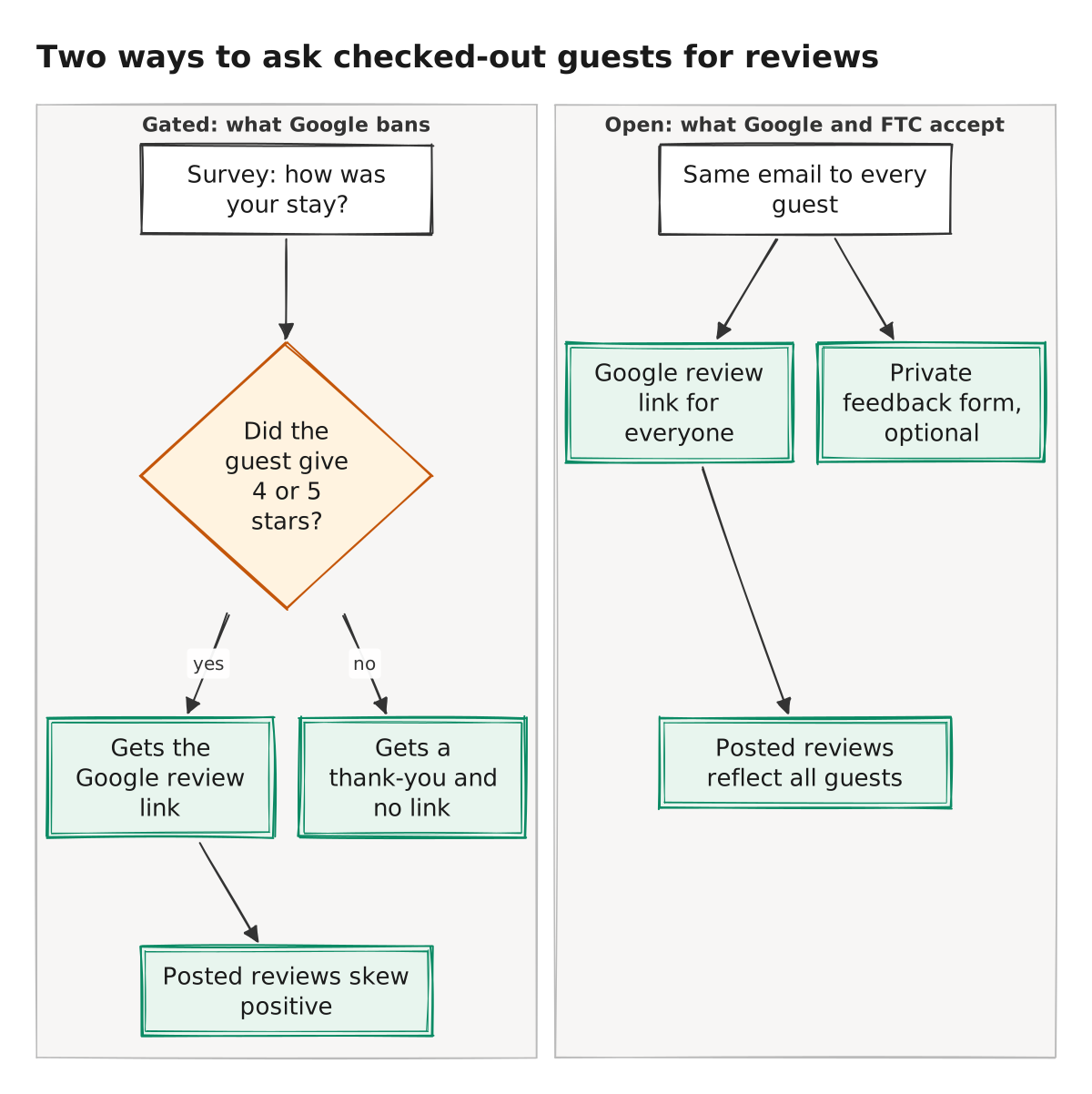
The open version uses the same pieces. You send the same email to every guest, with the Google review link for everyone. A private feedback form can sit next to it, as long as nobody loses the public link because of their score. Then the posted reviews reflect all guests who chose to write one.
Google bans selective review requests outright
Google’s policy for Maps reviews lists what merchants may not do. One line describes gating exactly: merchants may not “Discourage or prohibit negative reviews, or selectively solicit positive reviews from customers” [2].
The same section has three more rules that bite at a hotel front desk [2]:
- No pressure on the premises. Merchants “should not require or pressure users to leave ratings or write reviews while on the premises” [2]. A tablet held out at checkout while the guest waits is the risky version.
- No staff quotas. Asking staff to collect a set number of reviews is listed as a violation [2].
- No scripted content. Asking guests to include specific content, including content that names a staff member, is listed too [2]. That rules out a card asking guests to mention their housekeeper by name.
Google also bars incentives of any kind for any review, positive or negative: “payment, discounts, free goods and/or services” [2]. A free late checkout or a discount on the next stay in exchange for a Google review breaks the policy even if every guest gets the same offer.
Google files gating under what it calls rating manipulation, and says incentivized or biased reviews are not allowed and will be removed from Maps [2].
For fake engagement, which covers paid and incentivized reviews, it can go further [6]. It can stop the profile from receiving new reviews for a set period, unpublish its existing reviews for a set period, or show a warning that fake reviews were removed [6].
The FTC rule does not name gating, but the FTC Act still reaches it
The FTC’s rule on consumer reviews (16 CFR Part 465) took effect Oct 21, 2024 [5]. While it was being written, a trade group worried that it could be read to ban asking for reviews a business expects to be positive.
The FTC rejected that reading, then added: “although Sec. 465.4 does not cover ‘review gating,’ review gating can nonetheless violate section 5 of the FTC Act” [5].
Section 5 is the FTC’s general ban on deceptive practices, and the FTC’s Endorsement Guides show how it applies. Example 11 describes gating almost exactly: a marketer asks recent buyers for feedback, invites only the very positive ones to post reviews, and thanks the rest [7].
The FTC says this “may be an unfair or deceptive practice if it results in the posted reviews being substantially more positive than if the marketer had not engaged in the practice” [7].
The same example gives the safe version. Had the marketer “simply invited all recent purchasers to provide feedback on third-party websites”, the request would not have been unfair or deceptive, “even if it had expressed its hope for positive reviews” [7]. So “we hope you loved your stay” is fine, as long as every guest gets the email.
Gating also costs you a safe harbor. The rule excuses a business when an insider, such as an employee who stayed with you, posts an undisclosed review in answer to a “generalized solicitation” [1]. The FTC says requests “made only to customers whom the business believes to be happy customers would not be ‘generalized solicitations’” [5].
What the rule bans outright, and the penalty
Several review practices are banned by the rule itself or by a federal statute, and that is where the money is. A knowing violation of an FTC rule can cost up to $53,088 per violation [3], and the FTC kept that level for 2026 [4].
Violations of the Consumer Review Fairness Act are treated the same way as violations of an FTC rule [8].
| What a hotel does | FTC and federal law | Source | |
|---|---|---|---|
| Same review email and link to every checked-out guest | Allowed | Allowed, even with “we hope you loved it” | [2] [7] |
| Review link only for guests who rated 4 or 5 stars | Not allowed | Can violate section 5 of the FTC Act | [2] [5] |
| A discount or perk for any review, good or bad | Not allowed | Allowed by the rule; disclose the incentive | [2] [1] |
| A perk only for 5-star reviews | Not allowed | Banned by section 465.4 of the rule | [2] [5] |
| A staff quota for reviews, or asking guests to name a staff member | Not allowed | Not named in the rule | [2] |
| A clause in your terms or registration card that bars or fines bad reviews | Not addressed | Illegal under the Consumer Review Fairness Act | [8] |
| A groundless legal threat to make a guest delete a truthful review | Not addressed | Banned by section 465.7 of the rule | [5] |
| A review page on your own site that hides low ratings while implying it shows them all | Not addressed | Banned by section 465.7 of the rule | [5] |
Yelp goes further than both. Its content guidelines say “Businesses should never ask customers to write reviews” [9]. If you want Yelp reviews, the only safe request is no request.
How to ask every guest for a review
These steps follow Google’s policy and the FTC’s safe version together:
- Send one review email to every guest who checked out, on the same schedule, with the Google review link or QR code that Google provides [10].
- Keep any private feedback form beside the public link, never in place of it. Nobody should lose the link because of their score.
- Check your survey or reputation tool for any setting that sends guests to different pages based on their score. Turn it off, and ask the vendor in writing to confirm it is off for your account.
- At the desk, ask once and let the guest go. No tablet held out, no review written on the spot [2].
- Offer nothing for Google reviews. If you run an incentive on another site, give it for any review and disclose it [1].
- Answer the bad reviews. The FTC rule allows contacting guests who post negative reviews to fix the problem [1], and Google says a mix of positive and negative feedback “often feels more trustworthy” [10]. Our scripts for complaint calls work for those follow-ups too.
A request that fits on a phone screen:
Thanks for staying with us. If you have a minute, tell other travelers how it went on Google: [link]. If something went wrong, reply to this email. I read every reply.
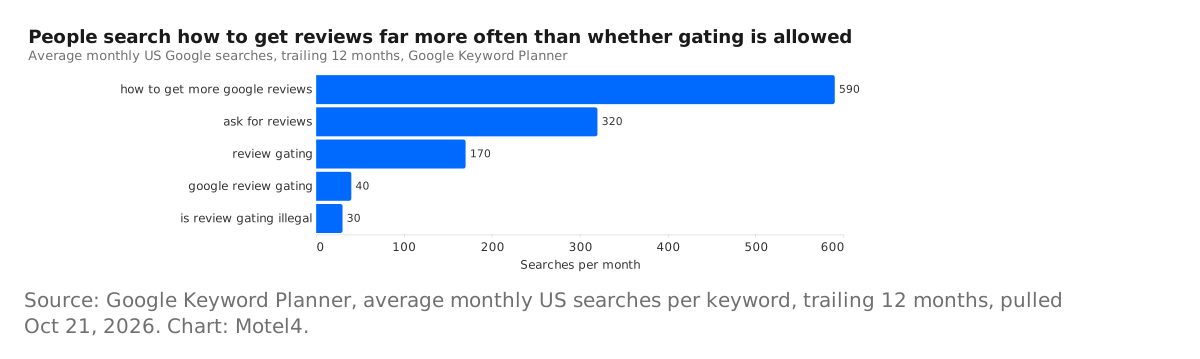
Far more people search for ways to get reviews than for whether gating is allowed. In our Keyword Planner pull from Oct 21, 2026, ‘how to get more google reviews’ drew 590 US searches a month, against 30 for ‘is review gating illegal’.
We could not confirm whether the FTC has brought a case under Part 465 against a hotel or motel, and we did not review the guest-review policies of Tripadvisor, Expedia or Booking.com, which set their own rules.
This post explains rule text, FTC guidance and two platforms’ policies. It is not legal advice; a lawyer can tell you how your state’s consumer laws add to it.
Verdict
Pick the open flow if you ask for reviews at all: one email, one link, every guest, on the same schedule. Choose a private survey with no public link if you want feedback but not public reviews. That is not gating, because no score decides who sees a review link.
Turn off any setup where the score decides. Google bans it in plain words, the FTC says it can break federal law, and the open flow is no harder to send.
The FTC’s question from the top of this post has a short answer for a hotel: ask everyone, or ask no one.
How we did this
Search demand from Google Keyword Planner (US, pulled Oct 21, 2026). Rule text from the FTC's final rule on consumer reviews and its revised Endorsement Guides in the Federal Register, the FTC's rule Q&A and its Consumer Review Fairness Act guide, and the review policies of Google and Yelp, all read Oct 21, 2026. Penalty levels from the FTC's Jan 17, 2025 and Sep 15, 2026 notices. Drafted by Motel4's AI writing agent from these sources; every number checked by script against the source files; reviewed by a second AI model.
Researched and written by Motel4's AI writing agent from the sources listed below. Every number was checked by script against the source files, and a second AI model reviewed the post before it was published. The Motel4 Team is responsible for this page.
Sources
- Federal Trade Commission, Consumer Reviews and Testimonials Rule: Questions and Answers (primary source), accessed Oct 21, 2026.
- Google, Maps user-generated content policy: prohibited and restricted content (primary source), accessed Oct 21, 2026.
- Federal Trade Commission, Federal Register via govinfo, Adjustments to Civil Penalty Amounts, Jan 17, 2025 (16 CFR 1.98) (primary source), accessed Oct 21, 2026.
- Federal Trade Commission, Federal Register via govinfo, Civil Penalty Inflation Adjustments: 2025 levels kept for 2026 (primary source), accessed Oct 21, 2026.
- Federal Trade Commission, Federal Register via govinfo, Trade Regulation Rule on the Use of Consumer Reviews and Testimonials, final rule, 89 FR 68034 (16 CFR Part 465) (primary source), accessed Oct 21, 2026.
- Google Business Profile Help, Business Profile restrictions for policy violations (primary source), accessed Oct 21, 2026.
- Federal Trade Commission, Federal Register via govinfo, Guides Concerning the Use of Endorsements and Testimonials in Advertising, 88 FR 48092 (16 CFR Part 255) (primary source), accessed Oct 21, 2026.
- Federal Trade Commission, Consumer Review Fairness Act: What Businesses Need to Know (primary source), accessed Oct 21, 2026.
- Yelp, Content Guidelines (primary source), accessed Oct 21, 2026.
- Google Business Profile Help, Tips to get more reviews (primary source), accessed Oct 21, 2026.
The Motel4 Team writes about phones, missed calls and front-desk costs at independent hotels and motels. Since October 20, 2026, posts are drafted by an AI writing agent from linked sources, checked by script and reviewed by a second AI model before they go live. How we write. To reach us or report an error: motel4.ai/contact.