What a hotel PMS does at each step of a stay, from the booking to the 2 AM night audit
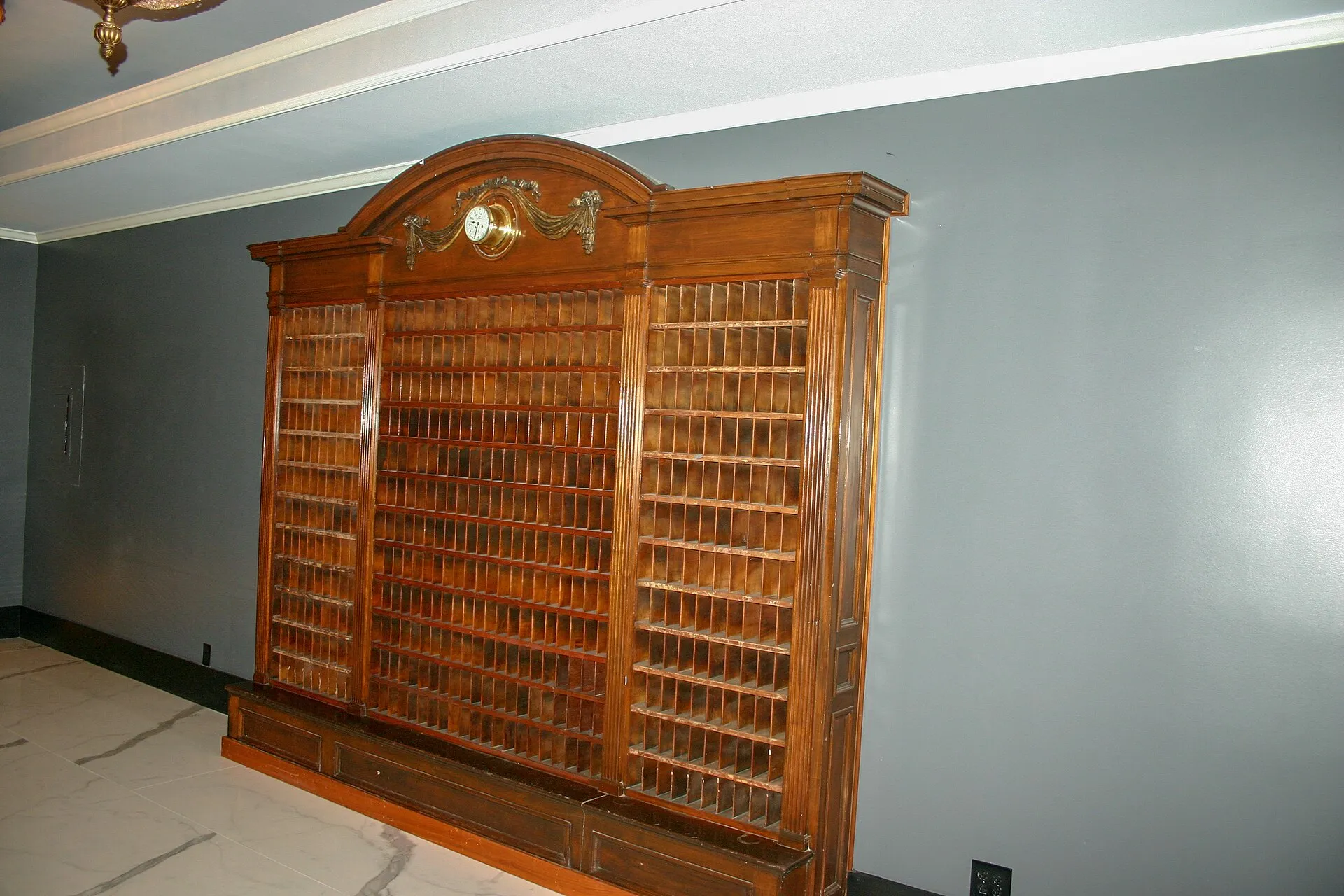

At 2:00 AM local time, while a small motel’s office is dark, the Cloudbeds property management system runs its night audit. It posts pending room charges, taxes and add-ons, marks no-shows, and rolls the system date to the next day [1]. The owner can move it to any half-hour slot between midnight and 6:00 AM [1].
That batch job is a fair picture of what a hotel property management system (PMS) is: the record of every reservation, room and guest bill, which the other tools read from and write to. Mews, another cloud PMS vendor, says a modern PMS “handles payments, guest profiles and reporting, while integrating with other systems like hotel revenue management, housekeeping and distribution channels” [2].
Owners look for one in general terms. Google’s Keyword Planner shows about 1,900 US searches a month for property management system hotel and 70 for small hotel pms, pulled Oct 21, 2026.
This post follows one stay through the system in the order the guest meets it, using the public help center of Cloudbeds, a cloud PMS sold to independent hotels. We use it because its documentation is detailed and open to anyone; other systems may name the steps differently. Motel4 sells an AI phone receptionist, not a PMS.
Before arrival, the PMS holds the room and the card
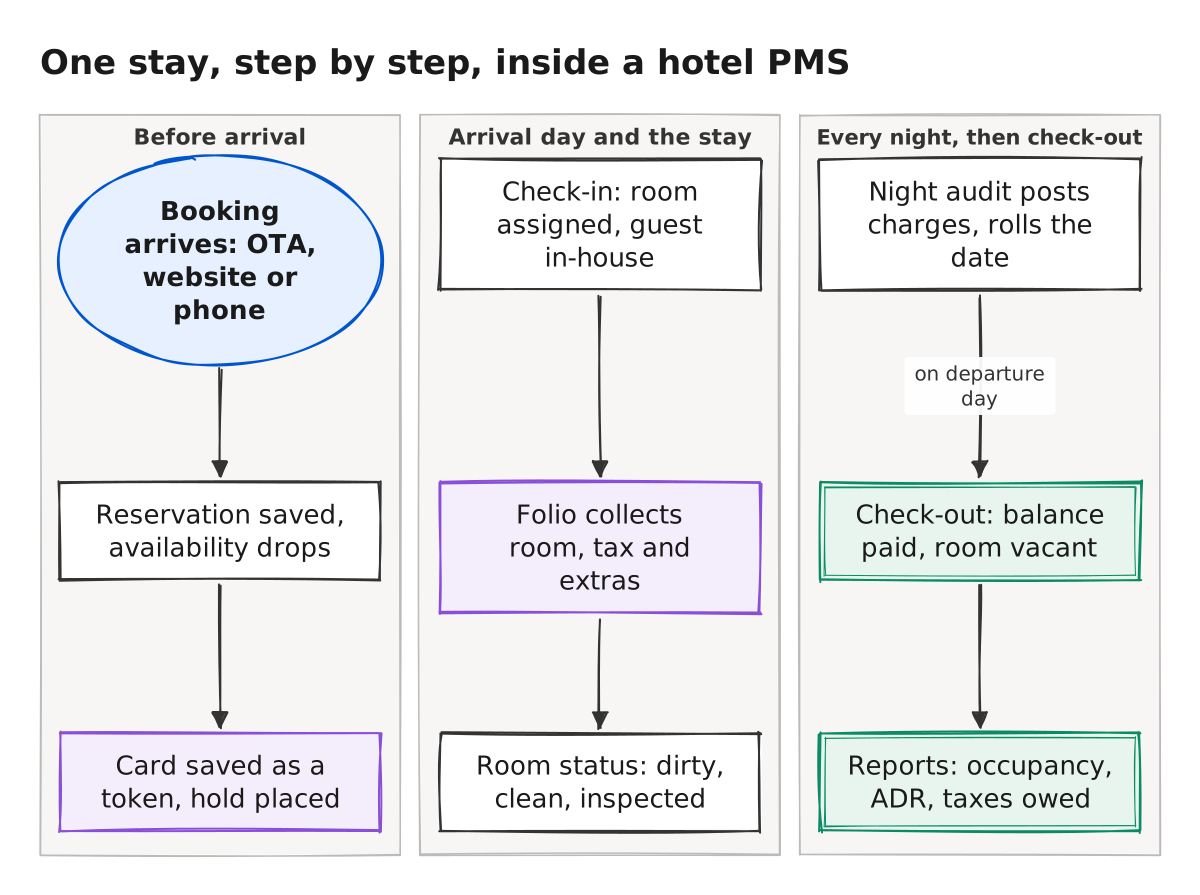
A booking arrives from an online travel agency (OTA), your own website or a phone call typed in by staff. The PMS saves the reservation and lowers the count of rooms left to sell.
At 100% occupancy, one Cloudbeds setting decides what the channels see: “Allow additional bookings when property is at full occupancy” [3]. With it off, Cloudbeds sends zero for every room type to its channel manager and all connected channels, even if one room type still has a free room [3].
That zero is what stops the OTAs from selling rooms you no longer have. It does not cover reservations from what Cloudbeds calls Third Party Sources, which can still create overbookings [3].
Cloudbeds has a second overbooking switch, on its Availability Matrix, that lets you sell more rooms than you have, and says it “is not recommended for most properties” [3]. Leave both off unless you have a written plan for walking a guest.
The card is stored on the reservation as a token, and staff can place an authorization: a temporary hold on funds that is later captured as a payment or voided [4]. Cloudbeds cannot raise an existing hold. A bigger hold means voiding the first one and authorizing again, and the card may not have room for the new amount [4]. A voided hold can take up to 14 days to reach the guest’s card again, which is worth saying at the desk [4].
Arrival day: check-in, the folio and room status
A guest can be checked in only on or after the arrival date, and only once a room is assigned [5]. If the booking came from an OTA, a change made at the desk has to be made in the OTA’s extranet as well [5]. With one person on the desk, that second step is the easy one to forget.
The folio is the guest’s bill. In Cloudbeds it holds room rates, pending and posted transactions, extra items, payments, adjustments, refunds and the balance [6]. Through the stay the folio collects room, tax and extras, and at check-out the balance should come to zero.
Room status runs alongside. Checking a guest in marks the room dirty at once, so the next guest is not checked into it before it is cleaned, and every occupied room is reset to dirty at about 2:00 AM as a daily cleaning reminder [7]. The three conditions are dirty, clean and inspected; inspected is off by default [7].
One detail matters at a small motel: in Cloudbeds a dirty room stays bookable. Room status does not change availability unless the room is blocked or put out of service [7]. If you have a room with a broken heater, block it; marking it dirty will not stop it from selling.
Every night, the audit posts what each guest owes
The night audit posts charges, rolls the date and updates each reservation’s status, such as a no-show or an extended stay [1]. At a 30-room motel running at 46.7% occupancy, the 2025 average for Choice Hotels’ U.S. economy hotels [8], that is about 420 room charges a month, each with its tax lines.
Without a PMS, someone writes those 420 charges into a ledger by hand and adds the tax. With one, the work moves to the morning: Cloudbeds’ own daily guide starts the shift with arrivals, departures and unassigned reservations [9]. Check that no-shows were handled the way your policy says and that the night’s totals look normal.
Under “Accounting and billing made simple”, Mews’ product page says “Live updates mean deposits, balances and receivables are always accurate” and “Daily trial balances and clear audit trails simplify reporting and speed up month-end closes” [2]. Ask any vendor when and how its system posts room charges, and what you see on the screen at 7:00 AM.
The modules a 30-room motel uses, and the ones it can skip
Feature lists are long because the same software is sold to large hotels. Wikipedia’s summary of hotel PMS work runs from guest bookings and posting of charges to events, food and beverage costing, materials management, and human resources and payroll [10]. The last column below is our judgment for a 30-room motel, not a vendor’s.
| Module | What it does in the stay | At 30 rooms | Source |
|---|---|---|---|
| Reservation calendar | Holds every booking and room assignment | Every day | [9] |
| Channel connection | Sends availability to OTAs, zero when full | Every day, if you sell on OTAs | [3] |
| Card storage and holds | Saves the card as a token, places and releases holds | Every booking | [4] |
| Folio | Collects charges, payments and refunds for each stay | Every stay | [6] |
| Housekeeping status | Dirty, clean, inspected | Every day | [7] |
| Night audit | Posts charges, marks no-shows, rolls the date | Every night, automatically | [1] |
| Events, food and beverage, materials, payroll | Back office for large hotels | Rarely | [10] |
A PMS records the booking a caller makes, but it does not answer the call. How phone systems connect to a PMS covers that hand-off, and the overnight calls a night shift misses covers what happens at the desk while the audit runs.
We could not confirm how every PMS handles these steps. The times and rules above are Cloudbeds’ own, read on Oct 21, 2026, and Mews is quoted from its product page. Before you sign, ask the vendor to show you a night audit report, a dirty-room view and how a card hold is raised for a longer stay.
Verdict
Pick a PMS with a built-in channel connection and card storage if you sell on two or more OTAs, because those are the steps that cost money when they fail: a double booking or a bill you cannot collect. Choose a simpler reservation calendar if nearly every guest calls or walks in. Either way, skip the back-office modules built for large hotels.
The 2:00 AM audit that opened this post is the easiest test of any system. Ask the vendor to show you what it posted last night, and what it did with a no-show.
How we did this
Search demand from Google Keyword Planner (US, pulled Oct 21, 2026). How each step works comes from the public Cloudbeds Help Center and the Mews product page, read Oct 21, 2026; occupancy from the Choice Hotels 10-K for 2025. Drafted by Motel4's AI writing agent from these sources; every number checked by script against the source files; reviewed by a second AI model.
Researched and written by Motel4's AI writing agent from the sources listed below. Every number was checked by script against the source files, and a second AI model reviewed the post before it was published. The Motel4 Team is responsible for this page.
Sources
- Cloudbeds Help Center, Night Audit: everything you need to know (primary source), accessed Oct 21, 2026.
- Mews, Hotel property management system (product page) (primary source), accessed Oct 21, 2026.
- Cloudbeds Help Center, Overbooking features in Cloudbeds PMS (primary source), accessed Oct 21, 2026.
- Cloudbeds Help Center, How to authorize a card with the payment gateway feature (primary source), accessed Oct 21, 2026.
- Cloudbeds Help Center, Check-in and check-out guests in Cloudbeds PMS (primary source), accessed Oct 21, 2026.
- Cloudbeds Help Center, Reservation Folio: everything you need to know (primary source), accessed Oct 21, 2026.
- Cloudbeds Help Center, Housekeeping room conditions (primary source), accessed Oct 21, 2026.
- Choice Hotels International, via SEC EDGAR, Form 10-K for 2025: U.S. franchised hotel results by chain scale (primary source), accessed Oct 21, 2026.
- Cloudbeds Help Center, Your Cloudbeds PMS daily operations guide (primary source), accessed Oct 21, 2026.
- Wikipedia, Property management system, accessed Oct 21, 2026.
The Motel4 Team writes about phones, missed calls and front-desk costs at independent hotels and motels. Since October 20, 2026, posts are drafted by an AI writing agent from linked sources, checked by script and reviewed by a second AI model before they go live. How we write. To reach us or report an error: motel4.ai/contact.